
Major Tender Launched for TF-5 Third Lane
The Canary Islands Government has taken a decisive step to reduce congestion on Tenerife’s northern motorway. Yesterday, the Regional Ministry of Public Works, Housing and Mobility announced the opening of the public tender to award the contract for constructing a third lane on the TF-5 between Tenerife North Airport and Guamasa, in the direction of Santa Cruz de Tenerife. This is a highly demanded intervention for Tenerife at the single most congested point across all the island’s roads. The works will begin next year, once the companies bidding for the contract are selected, and have a base budget of €66.4 million.
Construction firms interested in bidding for the project can submit their offers until 18:00 on 9 February via the Public Sector Procurement Platform. The regional government’s Minister for Public Works, Pablo Rodríguez, stated yesterday that this project is “very important” for improving mobility in Tenerife. “It will allow us to expand the capacity of the TF-5, an absolutely necessary and priority step to provide greater fluidity to a section with some of the points suffering the worst congestion difficulties,” Rodríguez emphasised.
Tenerife’s Traffic Blackspots
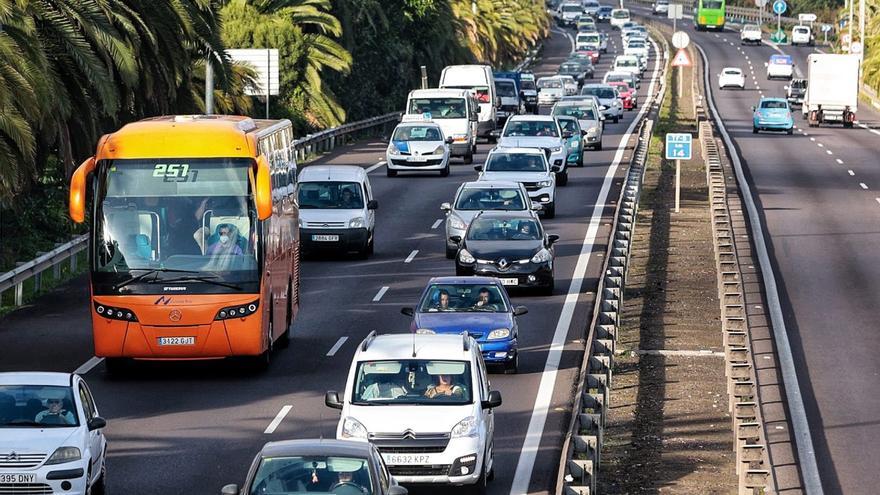
Almost seven out of every ten kilometres (66.4%) of the island’s two main motorways – the TF-1 to the south and the TF-5 to the north – are saturated, meaning they have traffic intensities above 50,000 vehicles on an average day. However, the worst bottlenecks are concentrated in just 10 points. The very worst is on the TF-5 at San Lázaro (La Laguna), with an average of 109,472 vehicles daily. No one escapes the agonising waits during the early morning rush hour heading downhill (towards Santa Cruz) and the early evening rush hour heading uphill on this section of the TF-5 between Santa Cruz and La Laguna.
This most congested point is precisely within the Los Rodeos Airport-Guamasa stretch where the third lane is to be built. The TF-5 accounts for four of the island’s 10 traffic blackspots: the aforementioned San Lázaro, plus the Taco bridge (100,716), Las Chumberas (106,902), and the exit from the capital (81,184 average daily vehicles). Heading further north, there are two other bottlenecks: Tacoronte (89,420) and El Sauzal (73,771).
Congestion Rivaling Mainland Spain
The level of congestion on the northern motorway is so severe that it comes very close to the most traffic-saturated road in the entire country, Madrid’s M-40, which at its peak point handles the transit of 185,344 cars each day. The comparison is not limited to analysing the Average Daily Traffic Intensity, which is 109,000 for the northern motorway, but includes parameters like the level of service, which bring it close to the highest congestion figures nationally.
Project Scope and Benefits
The project between Guamasa and Tenerife North Airport-Los Rodeos will mean a “significant” increase in the TF-5’s capacity in the direction of Santa Cruz de Tenerife, according to the Public Works Minister, as it expands from two to three lanes on this stretch. This will allow it to absorb a greater traffic intensity and improve driving conditions. The project also includes remodelling the Guamasa and San Lázaro interchanges, as well as constructing a new direct access link to Tenerife North Airport-Ciudad de La Laguna. This will separate traffic originating from and destined for the north and south.
This new configuration replaces the current scheme, based on a single interchange, with a more efficient system featuring differentiated access points. In this way, vehicles coming from the north will access the facility, also known as Los Rodeos, via the new link, instead of continuing to San Lázaro as is currently the case, the Canary Islands Government notes in a statement. This reorganisation will allow some traffic to leave the most congested section of the TF-5 earlier, directly contributing to improving the overall fluidity of traffic.
Complex Preparatory Work
The Public Works Ministry has been taking administrative steps in a very complex and costly process to reach the point it has just confirmed, which opens the door to the start of construction: the tender launch for the project. For example, it has been necessary to resolve the compulsory purchase of 8,000 square metres from seven properties belonging to companies, private individuals, and public institutions to pave the way for building this third lane on the northern motorway. This is a 3.6-kilometre stretch that will be extended further in future projects.
Among these compulsory purchases, the 5,737 square metres – 72% of the 7,974 square metres of urban land with special use characteristics – belonging to the Spanish Airports authority (Aena) stand out.
No post found!