
A Church Like No Other
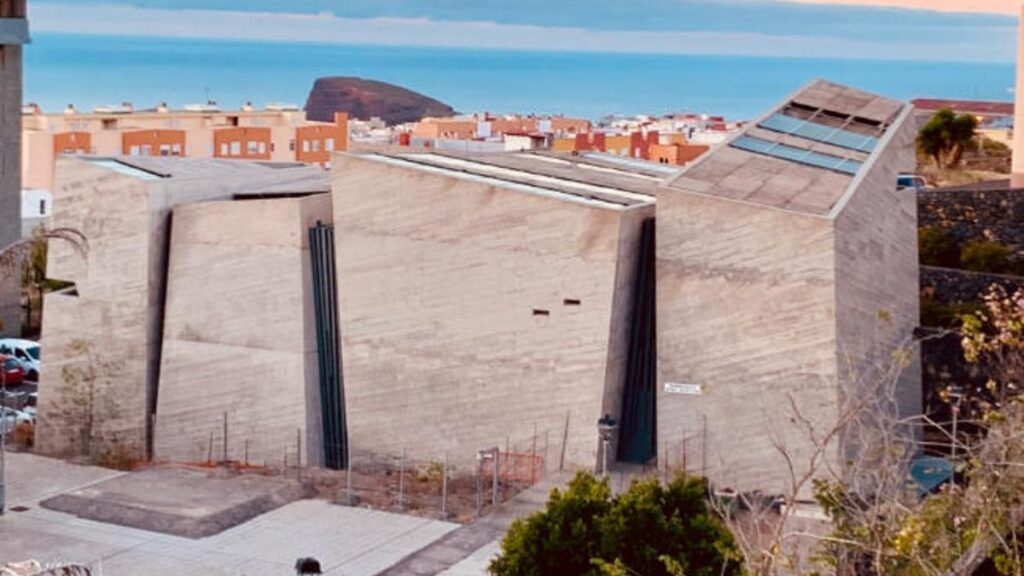
The world’s most singular church is found in Tenerife and has been recognised as one of the best examples of contemporary architecture. In Las Chumberas, a neighbourhood to the southeast of San Cristóbal de La Laguna, stands a building that baffles at first glance, because it looks like anything but what it truly is: a Catholic place of worship. Thanks to this structure, Tenerife boasts a unique artistic jewel on the planet.
International Acclaim for a Unique Design
The Parish Church of the Santísimo Redentor (Most Holy Redeemer) stands out for its unique form and unconventional silhouette, a design that has earned it international recognition at the World Architecture Festival (WAF) and completely sets it apart from other religious buildings on the island. Canarian architect Fernando Menis achieved his goal of creating “a space for meeting, reflection and urban transformation.”
Far removed from majestic Baroque basilicas, with no trace of imposing, sharp Gothic cathedrals, and sharing no elements with elegant Neoclassical churches, this singular construction rises up, equally marvelling and perplexing those who see it. Created in a brutalist style by Menis, the Church of the Santísimo Redentor in Las Chumberas was designed to be unique in the world.
Inspired by Tenerife’s Volcanic Heart
Completed in 2021 on a neighbourhood square, the complex includes a parish centre inaugurated in 2008 and a prayer area unlike any other on the island. The construction is made entirely of concrete and stone, intended by the architect to draw “inspiration from the volcanic geology of the island that hosts it.” The building emerges from the ground so that it “seems to rise from enormous moving rocks.”
This church is notable not just for its architecture, but also for its use of concrete made locally and stones extracted from the island’s soil. After fifteen years of work and several project phases, the parish was able to open thanks to donations from residents of Las Chumberas, private developers, and the Diocese of Nivariense.
Light, Sound and Community Spirit
The result is a set of four independent stone volumes, designed with exposed concrete and stone that evoke volcanic rocks. Between them, narrow structural fractures protected by glass and metal allow natural light to filter in. This light gives meaning to the interior: at dawn, a beam illuminates the cross behind the altar; at midday it bathes the baptistery, and later it projects onto the pews or the confessional.
Its solid concrete walls and thermal mass insulate the building, while its acoustic design, combining conventional concrete and porous volcanic stone, creates spaces with remarkable sound quality, ideal for holding mass, prayer, reading the Gospel, and choral singing. It also includes a columbarium where residents of Las Chumberas can place the ashes of deceased relatives.
A Catalyst for Community Change
Thanks to the collaboration of all parties, Fernando Menis achieved this project which is not only a religious space but functions as an engine for change within a traditional, working-class neighbourhood. With the support of the Bishopric of Tenerife, the church was conceived as a “place where there was none,” a point of identity for a historically fragmented community.
According to the WAF 2025 jury, the church is an outstanding example of community architecture. They highlighted that the complex “provides a vital meeting space for neighbours” by including both the temple and a social centre and public square. The organisation valued its ability to act as a catalyst for change in a fragmented urban environment.
Furthermore, the experts emphasised the inspiration drawn from the volcanic landscape, the expressiveness of its forms, and the transparency created by natural light, “generating intimate and spiritual spaces without adding superfluous elements.” Its structural design—”massive yet delicate in its fissures”—along with the use of concrete for structure, texture, and acoustics, was another strong point noted by the assessors.
A Growing Collection of Prestigious Awards
This WAF accolade adds to a series of recognitions already received by Menis’s church: the Faith & Form International Award for Religious Art and Architecture (Honor Award); the 2024 Frate Sole International Prize for Sacred Architecture (considered the ‘Oscar’ of religious architecture); and the ADF Design Excellence Award 2025 (awarded by the Aoyama Design Forum Foundation in Japan).
Beyond its architectural value, the Church of the Santísimo Redentor is a testament to community effort. Donations from residents, parishioners, and local businesses have made it possible for this construction to be not just a temple, but a place of social and religious cohesion.
No post found!