
A Futuristic Operating Theatre in Tenerife
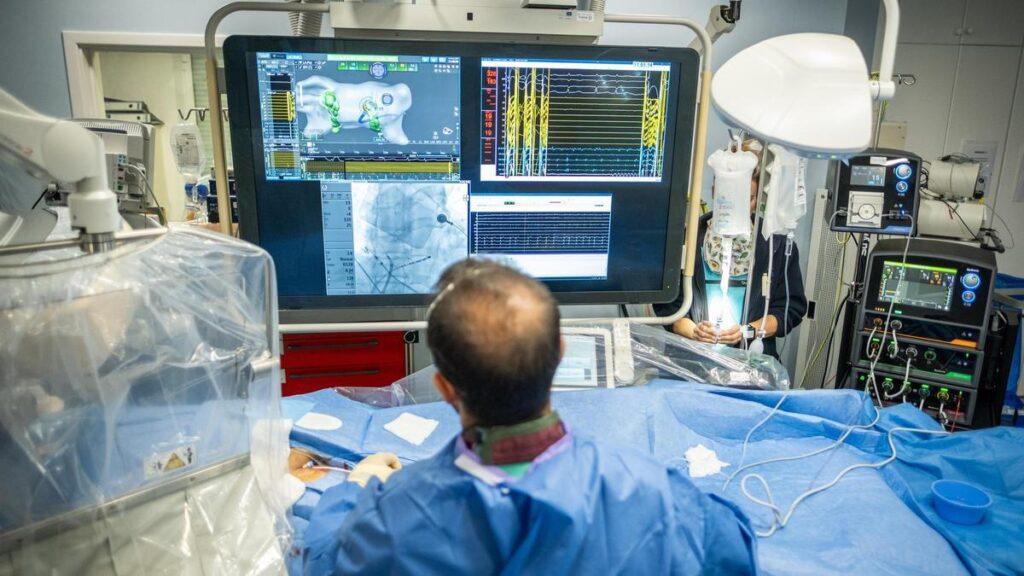
Life inside an operating theatre is a study in controlled, unpredictable frenzy. Several medical staff cluster attentively in front of monitors housed in a small but well-equipped cubicle, watching the real-time activity of a heart that is not functioning as it should. Just a few metres away, in the adjacent room, a man lies anaesthetised on a trolley, unaware of the meticulous technique a surgeon is performing to improve his quality of life. For the past month, the Hospital Universitario Nuestra Señora de Candelaria in Tenerife has been consolidating the use of a new material and a new technique that not only saves patients from a future heart attack but also allows them to go home within hours with a revitalised heart and minimal side effects.
The Science of Electroporation
This innovation in the hospital’s operating theatres stems from the application of so-called electroporation. The technique involves using controlled electrical pulses to carefully damage part of the junction connecting the heart to the pulmonary veins, performing a much cleaner and more precise ablation. The unconscious patient on the trolley suffers from an arrhythmia originating in one of the most common sites for these irregularities: the pulmonary veins. The goal is to prevent this erratic heartbeat from spreading and causing tachycardia or even a future myocardial infarction. After all, the pulmonary veins are conductors of blood flow.
An Immersive Surgical Suite
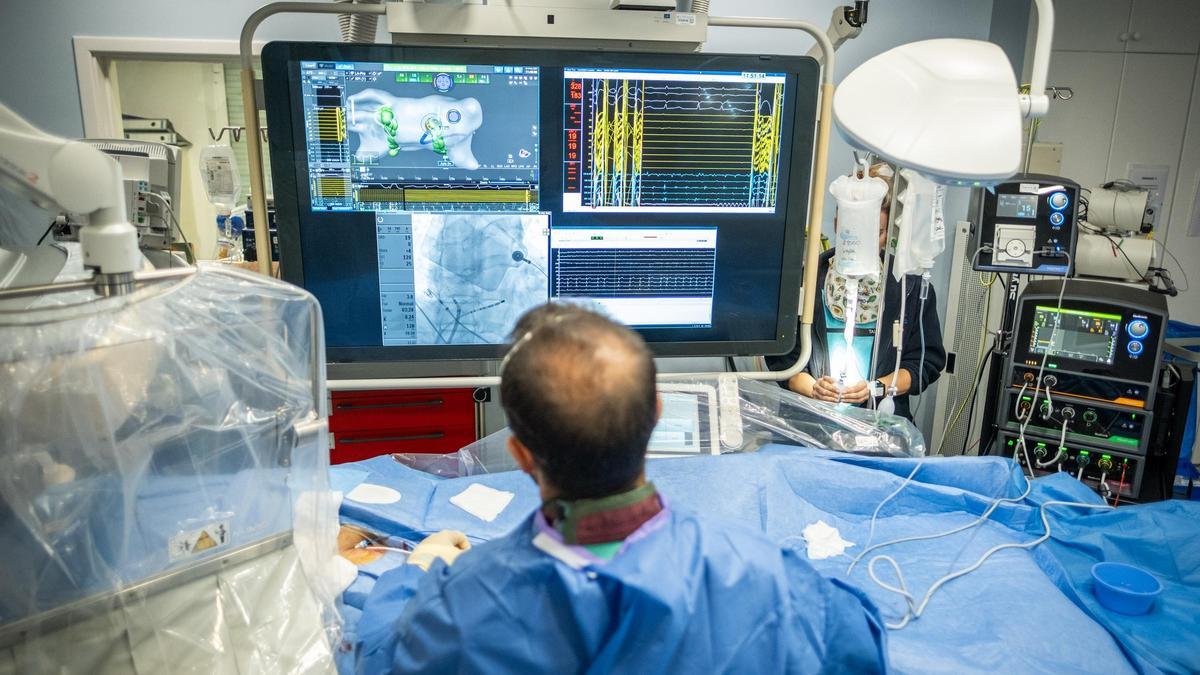
The two connected rooms inside the operating theatre resemble an elaborate, immersive video game. A visitor is met by an intense atmosphere where various members of the surgical team (surgeons, nurses, assistants, and anaesthetists) move in and out, get settled, give instructions, or watch the process intently. They observe images of the patient’s inner thoracic cavity on various screens, a 3D reconstruction of their heart, and an electrocardiogram emitting repetitive, synchronous beeps. Seated at a computer screen, one doctor uses a mouse to rotate the 3D representation of the patient’s left atrium, following instructions from his colleague inside the theatre so the surgeon can “see” better what he is doing and know where to direct the catheter.
In the inner room, facing the sleeping patient, that surgeon concentrates, probe in hand, on eliminating the selected tissue in the patient’s left atrium using electrical pulses. The aim of these controlled burns is to eliminate any possibility of the arrhythmia reaching the heart. In this case, the arrhythmia in the deeply sedated patient is generated by tissue that has detached from one of the four pulmonary veins connecting to the left atrium. “It’s a very common case,” explains Diego Valdivia, a surgeon at the hospital, who stresses that there is extensive scientific literature on how to resolve this type of heart problem.
A Safer Form of Energy
The novelty, however, is not the procedure itself—which has been performed for decades in operating theatres worldwide—but that the ablation is performed using electricity, as this avoids damaging other organs. “This is a procedure that has been around for several decades, but it is usually performed with other types of energy, for example, with heat-producing radiofrequency, with cold, or with laser,” explains Valdivia. Over time, however, it has been found that these types of techniques, although effective, cause some side effects. “We realised that on some occasions, it could be counterproductive for the patient,” Valdivia insists.
Risks in Pulmonary Vein Ablation
Specifically, as the surgeon reveals, it could cause perforations, fistulas in the oesophagus, or bleeding. “The biggest problem we had was with the ablation of the pulmonary veins, because they are in close contact with some nerves, the oesophagus, the bronchi, and other structures, and it posed a risk of damaging them,” he states. This is not the only innovation applied in this futuristic Canarian operating theatre in recent months. With the introduction of electroporation, the door has also opened to incorporating a finer catheter to perform these surgeries. A simple change that, however, also helps reduce the side effects associated with the intervention itself. “This new system allows for a dual application of energy: electroporation and traditional radiofrequency,” he insists.
This also allows for using one or the other depending on whether the area of application is thicker or thinner, more or less sensitive, or adjacent to another organ that could be damaged. It is worth remembering that this small tube must be inserted through the femoral vein—the fastest route to the heart—so if it is of considerable size, it can cause certain transient damage to the patient. “This can cause some problems that have traditionally forced us to keep the patient under observation for a few hours, but we believe that with the new diameter we could even reduce that time and make the surgery almost outpatient,” reveals Valdivia.
Towards Same-Day Discharge
The latter, however, will only become a reality with time and if the method proves as effective as it seems to promise. For now, this technical change is already achieving unprecedented results in treating patients with arrhythmias. “We finish the operation in less than an hour, and if we operate in the morning, the patient can go home in the afternoon,” he concludes.
No post found!