
Council Approves Extra €856k for Masca Management Amid Budget Shortfall
The government of the Cabildo de Tenerife, formed by the Canarian Coalition (CC) and the Popular Party (PP), agreed on 3 December to pay the public company Tragsa (Empresa de Transformación Agraria) for pending invoices relating to the ongoing initial phases of managing the Masca visitor centre and the access regulation system for the Masca Ravine path. This was done through an extrajudicial credit recognition of €856,109, backed during the latest island plenary session. After deducting income received by the company since July 2024, this figure represents a budget gap or overrun of €704,163—a shortfall that all indications suggest will be repeated or increased over the next 18 months, given that this service and the associated Titsa bus services have been renewed.
From Initial Budget to Mounting Deficit
The situation stems from a government council agreement on 3 July 2024, which approved a budget of €3.152 million for these services over a 17-month period. An initial payment of €122,661 was made, followed by a subsequent modification of €151,946. Income for Tragsa had been calculated at €3.029 million, hence an initial uncovered difference of €122,661 to compensate. Shortly afterwards, on 10 July 2024, the company adjusted the price of tickets because the service was confirmed to be running at a deficit of €151,946, due to only opening three days a week in 2024. A further €29,285 was authorised on 12 July.
This year, the existence of a budget shortfall amounting to €704,163 was confirmed, alongside the need to pay €856,109 for all invoices. The certified expenditure rose to €1.81 million, partially financed by income from ticket sales totalling €954,750, with the difference of €856,109 being invoiced, according to the official report. Consequently, after deducting the advance contribution from the Cabildo, the net budget gap stands at €704,163. Therefore, the initial forecast established in the economic feasibility study has not been met, making it necessary to authorise and provide additional credits amounting to €704,163 to cover the pending certification payments.
Audit Raises Procedural Concerns
On 14 November 2025, the Cabildo’s Audit Office stated in a report that the continuation of the service provision had been carried out without proper budgetary coverage and without following the rest of the procedures required by the regulations governing in-house contracts. It also noted the required prior audit of expenditure had been omitted. Therefore, it did not recognise the obligation, process the payment, or favourably intervene in these actions until this omission was addressed and resolved according to the stipulated procedure. This was done on 21 November and ratified by the government and the plenary session this December.
Opposition Slams “Failed Model” and Fairness
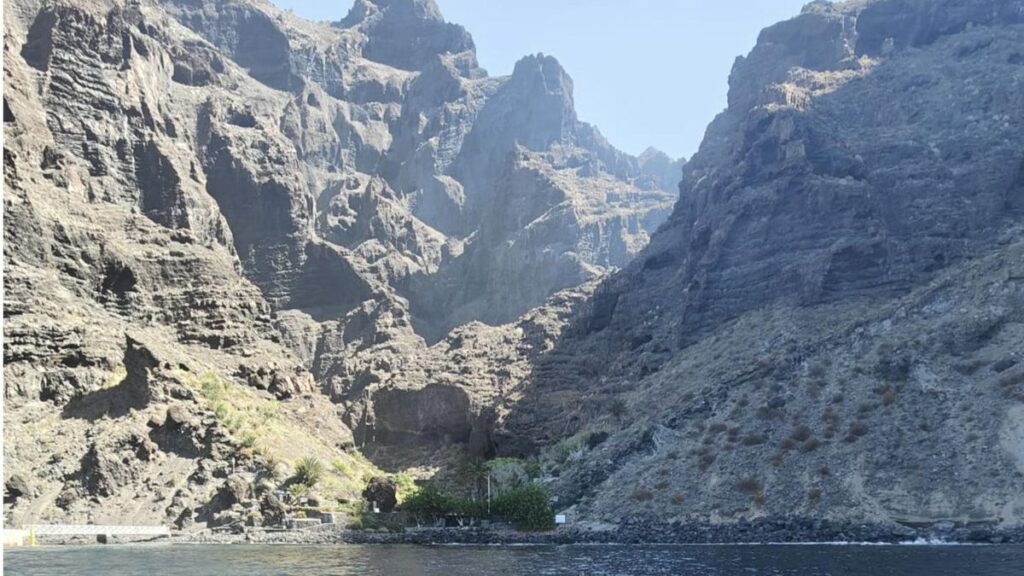
For the Socialist opposition, this confirms the failure of the model chosen by the President of the Cabildo, Rosa Dávila (CC), to manage the visitor centre and visits to the ravine and beach (which includes a jetty for the return trip, though this is still pending), given a deficit that is now coming out of the pockets of all island residents.
During this term, the new government of nationalists and conservatives opted to control visits to the ravine and the famous Masca beach, primarily for safety reasons and to conserve one of Tenerife’s most beautiful spots, which suffers from a very high visitor load from a sustainability perspective. This often caused congestion due to a lack of parking and a large influx of vehicles. This, in turn, led to the introduction of Titsa buses to regulate visits to the emblematic hamlet, while Tragsa’s role focused on the visitor centre and the ravine, providing guide and first aid services.
However, the deficit has been considerable, around €704,000, and is likely to be repeated in the coming years. In fact, the Cabildo has already issued a new contract to Tragsa and Titsa to provide this same service for the next 18 months, from 1 December 2025 to 31 May 2027 (the end of the political term). According to PSOE calculations, this could mean another nearly €900,000 in overrun costs.
Call for a Tourist Tax Instead
The Socialists therefore argue that what Rosa Dávila calls an ‘eco-tax’ is not one at all, but rather private prices paid by all Tenerife residents with their taxes. They contrast this with their proposed model of charging tourists an eco-tax per overnight stay in accommodation establishments. The PSOE shares the concerns about Masca’s carrying capacity but not the model chosen by Dávila and her rejection, along with the regional government, of any type of tourist tax.
Currently, all Tenerife residents have to pay to descend the ravine, with the exception of registered hikers, who are later refunded. The Socialists, however, consider it far fairer, more effective, and logical to implement an eco-tax on all visitors staying in hotels, apartments, or other accommodation on the island to fund these services. This would prevent them from running at a deficit and, therefore, stop Tenerife residents from footing the bill.
The island’s Socialist secretary, Tamara Raya, told Canarias Ahora that they have been denouncing this situation for some time. “We do not understand why the Cabildo de Tenerife has insisted, time and again, on punishing the citizens of this island with double taxation for the same thing. On one hand, we are already paying the so-called ‘Dávila cent’ tax on diesel or petrol, and on the other, they say they charge a fee to non-residents for visiting natural spaces like the Masca Ravine, but in reality, residents are also paying for it—even if it’s later refunded. Because it’s running at a deficit due to insufficient revenue, the Cabildo covers the cost, and therefore, it’s the people of Tenerife who pay. And all because they refuse to impose a tourist tax or levy to fund this type of expenditure on a finalist basis, so that residents don’t have to pay for it.”
No post found!