
Festive Pilgrimage to the Snow on Public Transport
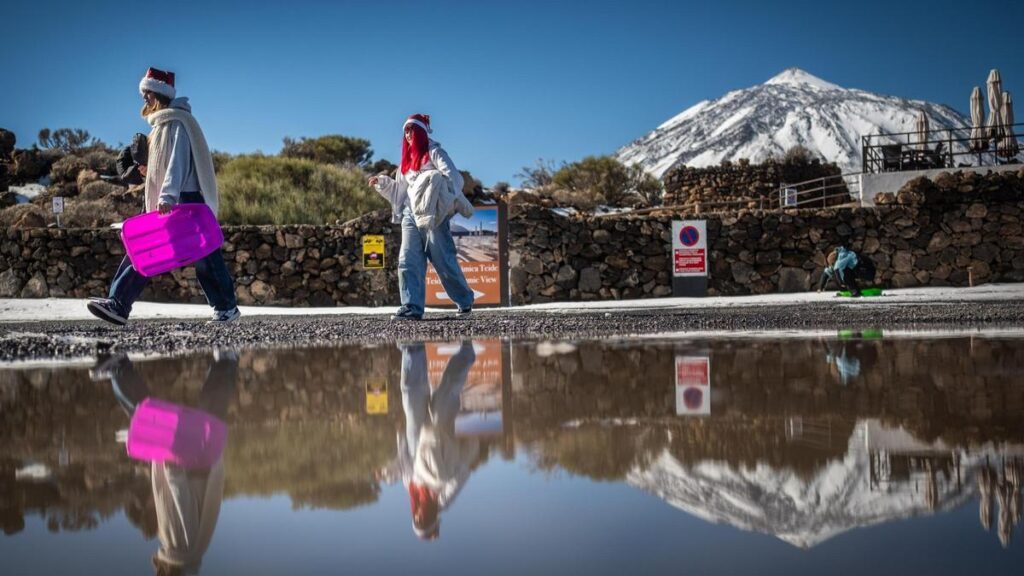
‘Operation Snow’ led thousands of Tinerfeños by free bus to Teide National Park this Saturday. By 3:00 PM, 1,200 people had already made the journey, with three hours still to go before the day’s end. The Cabildo de Tenerife (Island Council) expressed satisfaction with the initial balance, while a feeling of joy tinged with emotion prevailed for the majority who went up to see the snow for free, including many children. This festive day served as a general rehearsal for the mobility plan to be developed within the new Master Plan for Use and Management (PRUG). It didn’t matter that in areas like Izaña, few traces of snow from Storm Emilia remained, having been replaced by ice, frost, or technically, graupel (a mix of hail and powder snow). Despite this, there was no shortage of classic Christmas snowmen, intense snowball fights, and sledging down the slopes—even if they were more earth than snow—using everything from boards to mats.
A Classic Scene Without the Classic Traffic Chaos
It was a classic Canarian snow day but without the collapse of vehicles on the roadside, because for eight hours, from ten in the morning until six in the evening, car and motorbike access was prohibited from the three main cut-off points. Private transport was not allowed, except for emergencies or authorised workers. And the occasional privileged individual, like Lourdes at the wheel, who was also on duty to report on events. Across 190 square kilometres, distances feel enormous, even more so when carrying coolers, rucksacks, or bags as befits the portrait of the enthusiastic day-tripper that is the Tinerfeño and Canario. People of all ages and physical conditions embarked on a kind of ‘Walking Dead’-style pilgrimage with the fixed goal of finding snow. It was understandable that some tried to hitch a ride with the few authorised cars, caught between cheekiness and necessity.
The Logistics: Three Shuttle Routes to the Summit
“How are things up at Teide? Can you go up by car?” Diana, a neighbour from Ofra, asked this on Friday night, the day before the operation—which continues tomorrow, Sunday—to an acquaintance who works at the Cabildo. In the end, she changed her mind and didn’t go up on Saturday. Had she done so, she would have had to choose one of the enabled access points: from Vilaflor, arriving at the Cable Car; departing from La Esperanza and ending at the Izaña junction; and finally, from Aguamansa, at the entrance to the La Orotava Caldera, ending at El Portillo Alto.
Families and First-Timers Embrace the Experience
Darien, at just four months old, was the youngest passenger on one of the first buses from Aguamansa this Saturday. His parents, Marcos Canino and Mireia Bencomo, along with his paternal aunt, Raquel, and his 7-year-old brother, Tiago, brought him in his pram from Icod de los Vinos, where they live, to La Caldera de La Orotava, the designated parking area. Darien will be able to boast that at his tender age he already went up to Teide to see the snow, although upon arrival in the area of El Portillo and Siete Cañadas he was sleeping peacefully. The family wasn’t planning to stay long in the zone but showed their excitement for the moment. They believe closing access to control numbers is good but point out the need to enable more possibilities for locals.
Miguel Pérez came from Los Realejos with his whole family after leaving the car in La Caldera. He is happy to spend a day on Teide, although he has seen other snowfalls. He explains, “We are eight, aged between nine and 44; our idea is to enjoy it even if there isn’t much snow.” The measure of accessing by bus seems “brilliant, very successful, especially for local people.”
Business Concerns and Critical Voices
But not everyone viewed the closure of access to the national park so positively. For example, Elena, with over three decades of professional experience in the area, complained at the El Portillo restaurant about “seven days with hardly any customers, except to use the toilet.” She insisted that since the previous weekend there had been “no tourist coaches or motorbike excursionists,” who are her main clients. Tomorrow they had a booking for 200 people from the Imserso (Institute for Older Persons and Social Services) and have had to cancel it. Her colleague Javier González confirmed that “these are tough days. Businesses are barely making anything because those who come up bring almost everything with them and hardly consume. They only want to use the toilet, and bringing a water tank here for cleaning is very expensive for us.” Both were surprised when informed that the weekend operation allowed access for discretionary passenger transport from Vilaflor between 10:00 and 18:00.
Another critical view came from regular hikers like the brothers Adán and Alberto Arocha from La Orotava, and their cousin Daniel Arocha. They stopped for a coffee at El Portillo—at 6 degrees—after covering 12 kilometres from La Caldera where they left their car. Adán explained: “We came down the path that leads to the Benijos track. We did its four kilometres and then came up the Long-Distance footpath (GR) to here.” The idea of shuttle buses seems “good, especially when compared to the blockages from cars parked any which way, a terrible image.” However, “we don’t like being closed off. At least for those of us from here who go up with control, it doesn’t seem right to me. We are paying for the sins of others.” They wonder: “What if we go up by bicycle, what happens?” They believe the measure should be modulated, and that people need to get used to it.
A Magical First Snow for Many
On the other side were people who had never seen snow, particularly Latin Americans, whether residents or not. Like Venezuelans Marilyn Jorge and Carlos Andrés Betancourt and their sons, Abraham, 18, and Aitor, 11. They didn’t stop playing with what was now frost, and Marilyn summed it up: “This is a blessing.” They travelled halfway around the island by bus on the route Santa Cruz Transport Interchange-La Orotava Station-Aguamansa-El Portillo, but “it was worth it.” Even more so because this very Sunday they return to their country.
The buses coming from the south, from Vilaflor, were also full. Very close to the base of the Cable Car, a group of eight people of all ages played with the snow and didn’t stop taking photos. They are part of the same extended family, and it’s clear they are enjoying themselves. They are Colombians from San Andrés del Sur and Cali, “the capital of salsa,” a young woman clarified. They endured another marathon journey by car and bus, leaving their home in La Cuesta at half past seven in the morning.
The first-person Latin focus on such a special day was completed by the couple formed by David Ayala, from El Salvador, and Cuban Tania, both with decades of residence in the Canaries. With the bucolic image of Roque de Guajara in the background, they explained over a snack that they live and work in San Sebastián de La Gomera. They caught the first ferry on Saturday to Tenerife and return to the ‘Columbus Island’ on the last. David, first referencing his famous president Bukele, recounted that “I thought the road would be open, but in the end we found out the bus left from Vilaflor and we left the car there.” They enjoyed the 25-minute experience with Titsa (the public bus company). They expected more snow because Teide looks ‘loaded’ from La Gomera, but “it has been very good,” they emphasised, adding: “It’s very beautiful, we’re even getting hot because we came loaded with clothes, we look like onions.”
Driver and Council Hail Orderly Success
Luis is a Titsa driver and was on duty today. He defends the control and access by public transport to the national park because the alternative would be “the chaos of before, every time it snowed.” He remembers other occasions when temperatures dropped and cars parked on the roadside got stuck. Tow trucks “had to work until the early hours to get them out of that trap.” By 11:30, he and his fellow drivers had already taken ten buses full of passengers from Aguamansa. “Everything has gone very well.”
This was also the assessment from the Cabildo de Tenerife by mid-afternoon this Saturday. “People tell us it’s an opportunity to be able to go up for groups like the elderly.” There were no notable incidents, except for some dizziness from altitude sickness. There were areas with plenty of snow like the Minas de San José, Montaña Blanca, or the north face of Roque de Guajara, although it was necessary to walk a bit because in others like Izaña it was more ice than anything else. The reflection is that “we are all happy: the workers in the operation—about two hundred—the thousands of users, and also the managers of the area’s restaurants.” Furthermore, “the majority were local people, residents of the island.” The success of the initiative, highlighted on social media by the island’s president, Rosa Dávila, is demonstrated by images captured from the Brifor helicopter. ‘Operation Snow’ unfolded as a day of snow enjoyment, orderly and safe, based on free public transport for all visitors to the national park.
No post found!