
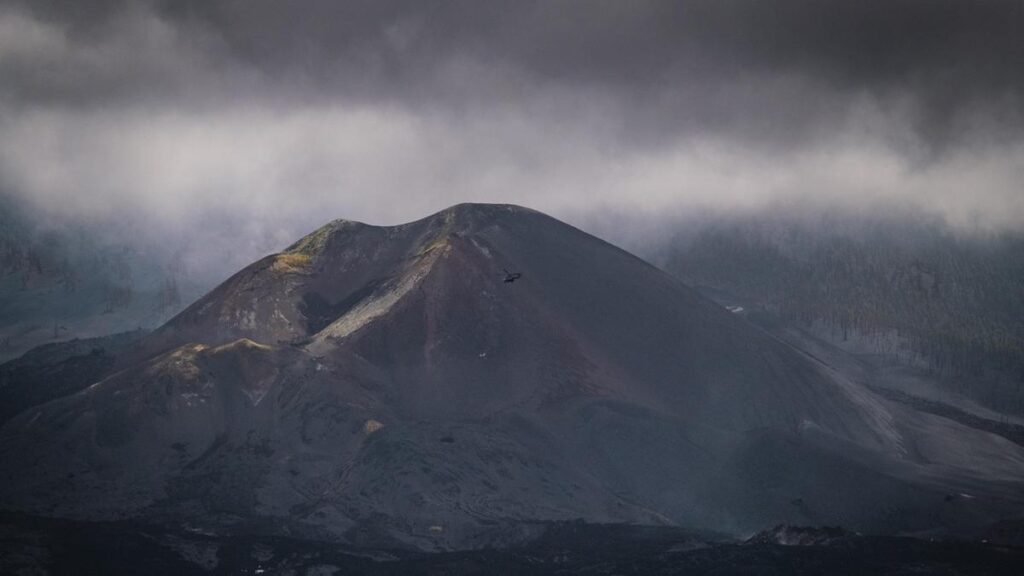
Tajogaite Volcano Sinks as Scientists Probe Hollow Structure
The Tajogaite volcano on La Palma has shrunk by 15 metres in height since it ceased violently spewing lava. Over the last four years, the eruptive cone has been gradually sinking in a process that shows no signs of ending. This circumstance has led a group of Canary Islands scientists to believe the massive structure may be hollow. For Pablo J. González, a volcanologist at the Institute of Natural Products and Agrobiology (IPNA-CSIC), it is very likely that “the volcanic tube has emptied completely after the eruption.”
Unravelling the Magma Drainage Process
Through topographical analysis, González and his colleague Thomas Walter from the University of Potsdam in Germany have sought to understand how magma drains away at the end of an eruption. The results of this work, presented at the International Tajogaite Congress held in Los Llanos de Aridane, La Palma, in late November, demonstrate that over the last four years the volcano has been “sinking and fracturing.”
Fractures That Changed the Eruption’s Course
The first fractures were, in fact, observed while the volcano was still spewing fire. “It was one of the most interesting aspects of the eruption; in the final weeks the cone began to fracture and sink, and distant fractures opened up,” recalls González. This occurred specifically on 2 December – just ten days before the eruption ended – when Tajogaite surprised observers by opening a vent far from the main cone that proceeded to emit lava for hours.
As this happened, a large fracture appeared on the southern flank of the cone, revealing a fault system 170 metres long and up to 50 metres wide. “It caused subsidences of up to four metres and the appearance of holes more than 30 metres in diameter,” explains González. This entire episode coincided with a change in eruptive activity. And so, while the south was sinking, the north opened a new vent that fed lava flows towards areas previously unaffected.
Topography Guides the Cracks
In fact, “these fractures are not random.” They open following the shape of the landscape. That is, in areas where the terrain is higher, the fractures separate and create elongated, lens-shaped figures. In lower areas, the cracks converge at a single point, making it easier for new pathways to open where lava can emerge.
In the eyes of the scientists, this phenomenon is especially relevant. “This behaviour has direct consequences: it can change the direction of lava flows, open new emission points, and ultimately modify the risk within a matter of hours,” states González.
Reconstructing the Event Through Technology and Models
To reconstruct this history, the researchers used a combination of observations: radar images from satellites, and images and models of the changing topography thanks to data captured by drones, as well as static cameras arranged around the cone, which recorded the opening of cracks and changes in eruptive activity minute by minute.
However, to understand how this large volcanic system worked, the researchers developed analogue models (using a mixture of plaster and sand) in the laboratory with which they were able to simulate how fractures propagate under complex relief. “These experiments confirmed that the topography diverted the fractures, conditioning the location of new craters,” reveals the researcher.
Why Is the Volcano Shrinking?
With this model they have also been able to discern that the loss of height may be related to two circumstances: because the material that forms it has been compacting and settling under its own weight as it cools; or because the magma that was beneath the crater has shifted, leaving those “voids” that cause the surface to sink more easily.
“To discern this, we used our laboratory model to see what the behaviour would be from material loss (collapse of material into possible empty conduits under the crater) and geotechnical experiments with hydraulic presses subjecting the ash to constant pressure to simulate the gravitational effect,” he explains.
Vital Knowledge for Future Risk Management
For the scientists, understanding this phenomenon is vital for being able to better manage risk. “Knowing that a cone can reorganise itself in a matter of hours, open new conduits and change the direction of lava flows is vital for planning evacuations and protecting infrastructure.”
No post found!