
Candelaria’s Monumental New Landmark
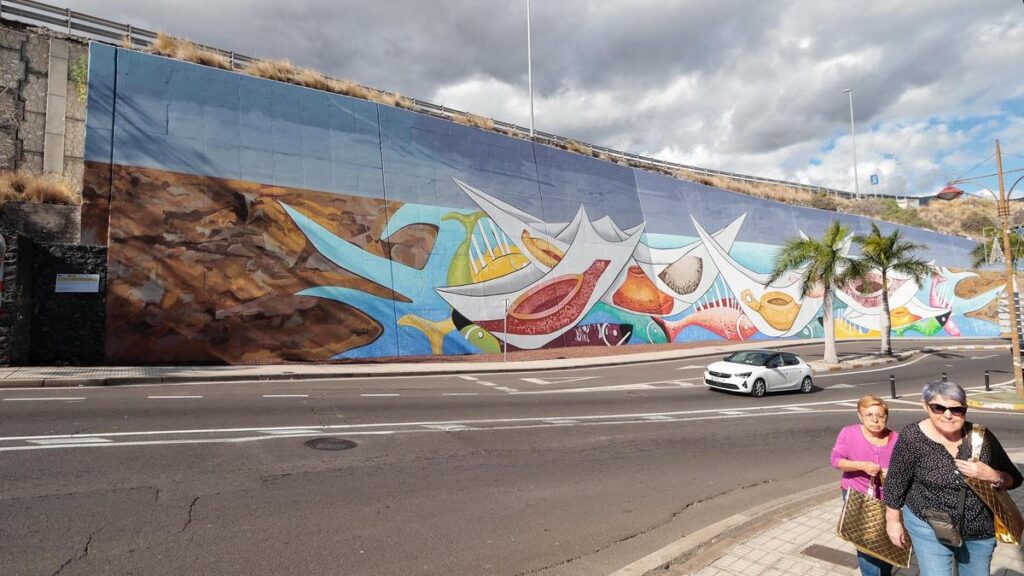
The largest mural in the Canary Islands can now be found in Candelaria, Tenerife. It is situated on a retaining wall of the TF-1 motorway, at the roundabout which distributes traffic towards the Plaza de Teror and Santa Ana upon entering the municipality. The work is based on the original sketches of the celebrated Canarian artist Pepe Dámaso and covers a vast surface area of 1,100 square metres. This scale makes it one of the largest public murals anywhere linked to the artist’s body of work.
A Vision Two Decades in the Making
The mural draws inspiration from sketches created by Pepe Dámaso back in 2004. At that time, he conceived a series of visual elements connected to pilgrimage, fishing, and pottery, intended for the entrance to the town, which had remained unrealised until now. The project was overseen by Alejandro Tosco and executed by muralist Irene Morales alongside her colleague Roy Reta, who respected the original spirit of the creator while adapting it to the demands of the large format and urban setting.
Overcoming Technical and Weather Challenges
Morales explains that the process was long and complex. “The proposal came to me in January, but they have been working on the project for years,” she notes. They were unsure if the mural would ever see the light of day, but finally received the green light in September. Work began on the motorway retaining wall on 22 September, with completion and presentation not taking place until 18 December.
During execution, the team faced various technical and weather-related difficulties. These included the breakdown of the elevating platform that helped them paint the upper part of the wall—a setback which forced them to continue painting from the ground—as well as poor weather conditions like wind and rain. “They set us back quite a bit and it was a struggle, but we managed it and we are very happy and proud of the final result,” Morales states.
Adapting the Design for Maximum Impact
The initial design also underwent modifications from the first concepts. “The sketch that is now rendered is not the initial one,” she explains. The previous design used the white of the wall and played with negative space, but they ultimately decided to modify it, preferring to fill the entire surface. Furthermore, Morales emphasises the importance of adapting the work to the visual impact generated by a surface of these dimensions at a key entry point to the town.
Durability was another key aspect of the project. To guarantee it, they had to use specific materials and techniques. “The most important thing is the base; once you have a good base, the material lasts,” points out the artist, who highlights the technical advice received to adapt the paint to the local climate and the exposure of the site. The painting work itself was carried out by a small but coordinated team: “We always had two people painting and two others providing support.”
Securing an Artistic Legacy
The mural culminates a project conceived over twenty years ago and is closely linked to the work La luz del Peregrino (The Pilgrim’s Light), created by Pepe Dámaso in 2004 and inspired by Candelaria. The Town Hall acquired the mural sketches and several pieces from this collection in 2023 for €30,000, along with the exclusive transfer of the work’s exploitation rights. This secures an artistic legacy that can now be enjoyed at one of the municipality’s busiest access points.
No post found!