A Young Obsession with the Human Body
From a very young age, Juan Negrín (Las Palmas de Gran Canaria, 1892 – Paris, 1956) was obsessed with understanding the inner workings of the human body. This native of the Canary Islands, known to some as a medical researcher and to others for his brief political career, meticulously studied the circulatory system. He searched for impulses—beyond the heart—that could explain the function of specific organs, particularly those in the stomach and pelvis, such as the liver, stomach, pancreas, adrenal glands, small intestine, and colon, which are directly connected to the splanchnic system.
A Hidden Scientific Treasure Comes to Light
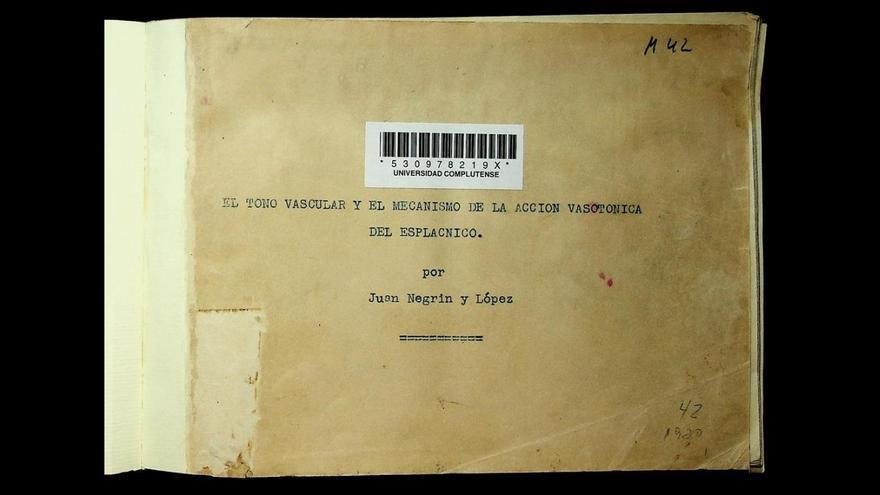
The thesis he presented in 1920 at the Complutense University of Madrid is one of the best-kept treasures of the exceptional scientific career of this Canary Islands physiologist. For the first time, this document has been made available to the public by the Complutense University of Madrid, with the help of the Juan Negrín Foundation. The scientific work that Negrín presented to the Central University of Madrid—as the Complutense was known before 1970—has now been digitized. Titled “El tono vascular y el mecanismo de la acción vasotonica del esplácnico” (Vascular Tone and the Mechanism of the Vasotonic Action of the Splanchnic), the document spans over 100 pages and includes the scientist’s dissertations, his signature, and that of the evaluation board. However, the typewritten document also shows some damage and even tears in the places where the scientist himself had placed graphs or images.
Groundbreaking Research in Modern Medicine
In his dissertation, Negrín sought to clarify the existence of a direct and exact neurological control of blood glucose levels and to determine the influence of an indirect regulatory mechanism through adrenaline levels in the blood. Following the discovery of epinephrine in the early 19th century, many researchers focused on studying how this and other compounds functioned in the body. In fact, Negrín’s thesis aligns with the most common types of studies of the era, which laid the foundation for modern evidence-based medicine.
A Promising Career Interrupted by War
The thesis recently published by the UCM was actually Negrín’s second doctorate. He had previously earned his medical degree in 1912 from the University of Leipzig in Germany, one of the most prestigious institutions of the time, at just 20 years old. The German academy, specifically the Ludwig Institute of Physiology, promised him a bright future as a physiologist, but his career plans were soon cut short. With the outbreak of the First World War, Negrín was forced to flee the bombing and took refuge in his homeland, Gran Canaria.
A Forced Return and Rapid Success in Spain
From the islands, he tried to resume his scientific career by applying for one of the new grants from the Board for Advanced Studies (JAE), a program to fund scientific exchange with centers in other countries, championed by the biologist Santiago Ramón y Cajal. Negrín’s plan was to continue his training in the United States, but Ramón y Cajal, aware of his previous work and brilliance, instead proposed that he direct the newly created Laboratory of General Physiology at the Residencia de Estudiantes in Madrid. His move to Spain required him to validate his German degree and earn a new doctorate. He did this in record time. Just four years later, in 1919, he validated his German medical degree after passing an exam with top honors. Less than a year later, on June 26, he defended his thesis and became a doctor in Spain. Two days after that, on September 26, he won the extraordinary award alongside Carlos Jiménez Díaz, and on March 4, 1922, he obtained the Chair of Physiology in Madrid. To earn his Spanish doctorate, he had to complete postgraduate courses and present a doctoral thesis, which received top marks and has now been recovered in digital format by the Complutense University, available to researchers and other interested parties through its website.
Accessing Negrín’s Work Today
Negrín’s work can be consulted in the “Theses of Relevant Figures” section of the Complutense Digital Heritage (PDC) portal. Through this platform, the University’s library ensures the preservation of its important bibliographic collections.
The Political Path of a Reluctant Leader
However, Negrín is also known for his political commitment. He joined the Spanish Socialist Workers’ Party (PSOE) in 1929 under the guidance of Indalecio Prieto during the dictatorship of Primo de Rivera. In 1931, he was elected as a deputy for Las Palmas, a position he held until his leave of absence in 1934. Negrín had little interest in Marxist theories, never maintained relations with trade unions, and belonged to the “Prietist” wing of the party. He professed a moderate socialism and was convinced of the need to establish a secular education in Spain to progress as a country.
Exile and Legacy
In 1937, in the midst of the Civil War, Negrín was tasked with leading democratic Spain until the end of the war, after which he was forced into exile as a political refugee. His assets were confiscated by Franco’s authorities, he was fined the exorbitant sum of 100 million pesetas by the regional court of the Law of Political Responsibilities, and the Special Tribunal for the Repression of Freemasonry and Communism sentenced him to thirty years in prison. At the end of the conflict, he settled in France and later moved to London, from where he continued to preside over the Government of the Republic in exile until 1945. Shortly after, he moved to Mexico and ended his days at the age of 64 in Paris.