
Canary Islands Telescope Reveals Galaxy’s Mysterious Arms
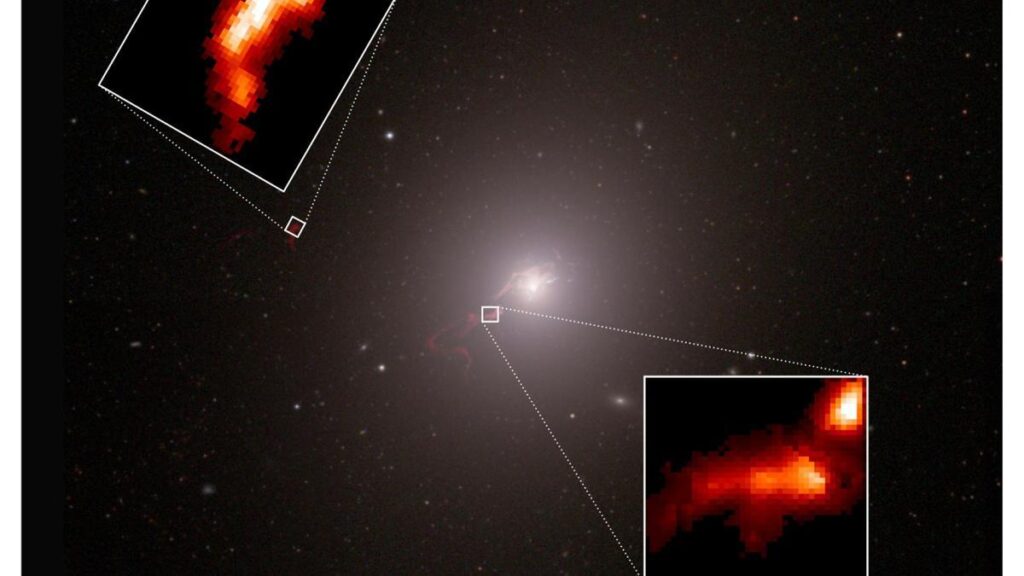
The Gran Telescopio Canarias (GTC or Grantecan), located on La Palma, has captured the most detailed image yet of the long, mysterious filaments extending from the galaxy M87 with unprecedented precision. These enigmatic structures have captivated scientists worldwide not only for their immense length—which sees them stretching beyond the galaxy’s limits—but also for their energy, their capacity to shape their surroundings, and their interaction with a central piece of the puzzle: the galaxy’s massive central black hole, famous for being the first ever to be photographed.
The Engine at the Heart of M87
Located some 55 million light-years away, M87 is a giant elliptical galaxy known for the extremely active supermassive black hole at its core. This cosmic energy engine, with a power equivalent to 6.5 billion solar masses, was revealed to the world in 2019 by observations from the Event Horizon Telescope. Those images, which spread across the globe in mere hours, showed what was until then believed impossible: seeing a galactic structure that, by definition, absorbs light and should therefore be invisible.
This black hole plays a fundamental role in shaping the galaxy. It is responsible for launching jets of high-energy particles that extend far beyond the galaxy itself. The strength of these energetic jets depends on the amount of material the black hole consumes, meaning there are times when they go through very active periods followed by quieter ones. Despite these fluctuations, they play a significant part in shaping both the galaxy and the hot gas surrounding it.
Unravelling the Mystery of the Filaments
However, the most unusual characteristic of this galaxy, located in the Virgo Cluster, is the complex network of long, thin filaments that run through it and extend far from its centre, like long arms. Despite decades of study, the origin of these structures remains uncertain. “M87 is the closest known galaxy with this type of filamentary structure,” explains Camille Poitras, lead author of the study and a master’s student at Laval University in Quebec, Canada. “It is probably one of the few that has filaments so far from the centre that they appear separate, floating beyond the galaxy,” she states.
Astronomers have long known these filaments in M87 are in constant motion. Previous studies have shown those near the centre are highly turbulent and chaotic, disturbed by the powerful jets from the black hole. The new observations provide far more information. They have determined that closer to the centre, the filaments are affected by the black hole and its active jets and show different chemical signatures from the gas further out.
A Tale of Two Environments
Further out, the picture changes completely. The separate outer filament moves in a more stable and uniform way, and its presence seems linked to an energetic event in the past. Specifically, the team also determined that, as they move away from the nucleus, these filaments are also stirred by smaller, local movements, likely caused by explosions of old stars known as Type Ia supernovae, which are common throughout the galaxy.
Furthermore, they found the chemical composition of these distant branches differs from those at the root. The distant filament shows an unexpected composition for such a tranquil zone, suggesting there may be underlying processes at work that are not yet fully understood. “These new observations have helped us determine how the flows from M87’s black hole shape and energise these filaments,” explains Marie-Lou Gendron-Marsolais, an adjunct professor at Laval University and co-author of the study. “They are ‘living’ proof of how the black hole affects the galaxy, even far from its nucleus,” she notes.
Canarian Contribution to a Cosmic Puzzle
The Canary Islands played a special role in this discovery. To better understand these filaments, the international team of astronomers combined two complementary sets of observations. First, they used the MEGARA instrument on the Gran Telescopio Canarias (GTC) to study two unique regions: complex filaments near the centre, close to the current jets, and another much further out, almost beyond the galaxy, in a calmer environment.
To complete this picture, the team also used new observations from the Canada-France-Hawaii Telescope (CFHT) with the SITELLE instrument, which provided a panoramic view of the entire filament network. Combined, these datasets offer the most comprehensive view to date of the filaments of M87, revealing their motions, composition, and connections to the surrounding environment.
Thanks to MEGARA’s high resolution, the team uncovered the relationship between the motion of the outer filaments and past events. “MEGARA’s ability to provide spatial information about these filaments, combined with the sensitivity afforded by a telescope like the GTC, has been fundamental to studying these very subtle structures in detail,” says Antonio Cabrera Lavers, head of scientific operations at the GTC.
These results show the filaments are closely related to the current and past activity of M87’s supermassive black hole. A combination of different processes—including the jets, stellar explosions, and the interaction between hot and cold gas—appear to work together to shape and move these delicate structures. Understanding how these processes combine remains a challenge, but future high-resolution observations and innovative analysis techniques will be key to revealing how they form, survive, and evolve over time.
No post found!