
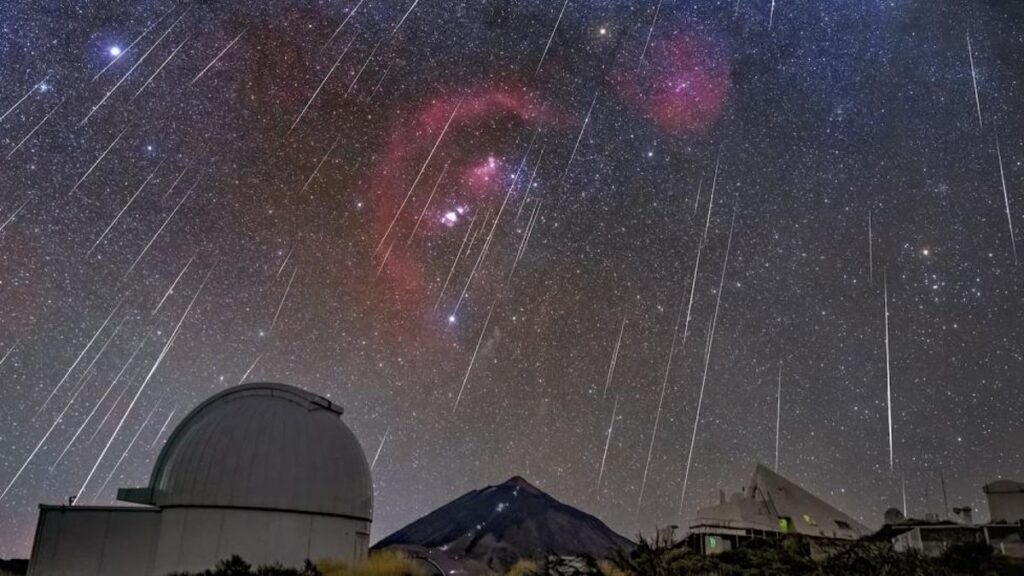
Geminid Meteor Shower Promises Dazzling Display
The Geminid meteor shower of December will reach its peak of activity in the early hours of Saturday 13th to Sunday 14th December. Although less famous than August’s Perseids, the Geminids can surpass them in spectacle, being brighter, more numerous, and moving more slowly, which allows for longer enjoyment of each streak across the sky, according to a statement from the Institute of Astrophysics of the Canary Islands (IAC).
When and Where to Watch
The Spanish research centre detailed that the maximum activity is expected around 08:00 on Sunday 14th December. However, as this will already be daylight, the best time to enjoy them will be the night of Saturday 13th, specifically between 01:00 and 03:00 in the early hours (Canary Island time). During these hours, total darkness is guaranteed, and Gemini, the constellation from which the meteors appear to radiate, will be sufficiently high in the sky for an excellent viewing angle. Under ideal conditions, up to around 150 meteors per hour could be spotted, surpassing the Perseid average by 50%.
Perfect Viewing Conditions
The IAC notes that the enemy of meteor observation is moonlight. Fortunately, this year the Moon will be in its waning crescent phase and will not appear in the sky until around 03:00. The radiant point of the shower, in the constellation of Gemini, appears around 20:00, so meteors will gradually begin to appear from that moment onwards.
A Unique Origin: Asteroid 3200 Phaethon
The IAC indicates that the origin of the Geminids is what makes this shower truly unique. Unlike most meteor showers, which come from comets, the Geminids originate from an asteroid: 3200 Phaethon. This object, about 5 to 6 kilometres in diameter, is classified as a hybrid, exhibiting characteristics of both a comet and an asteroid.
Phaethon has an orbit that brings it considerably close to the Sun (at its perihelion). Every time this occurs (its orbital period is 523 days), the intense heat causes its surface to release dust and small fragments. These fragments are distributed along its trajectory. Each December, the Earth passes through this trail of particles, which disintegrate upon entering the Earth’s atmosphere, generating the impressive meteor shower.
No Cause for Concern
Finally, the IAC highlights that, despite its classification as a Potentially Hazardous Object due to the proximity of its orbit to Earth’s, calculations of its trajectory are precise and there is no risk of collision with Earth for the next few centuries. “The only interaction we have with Phaethon is the dust it gifts us for this annual spectacle,” concludes the statement.
No post found!