
Europe Enters the Fray for La Palma Telescope
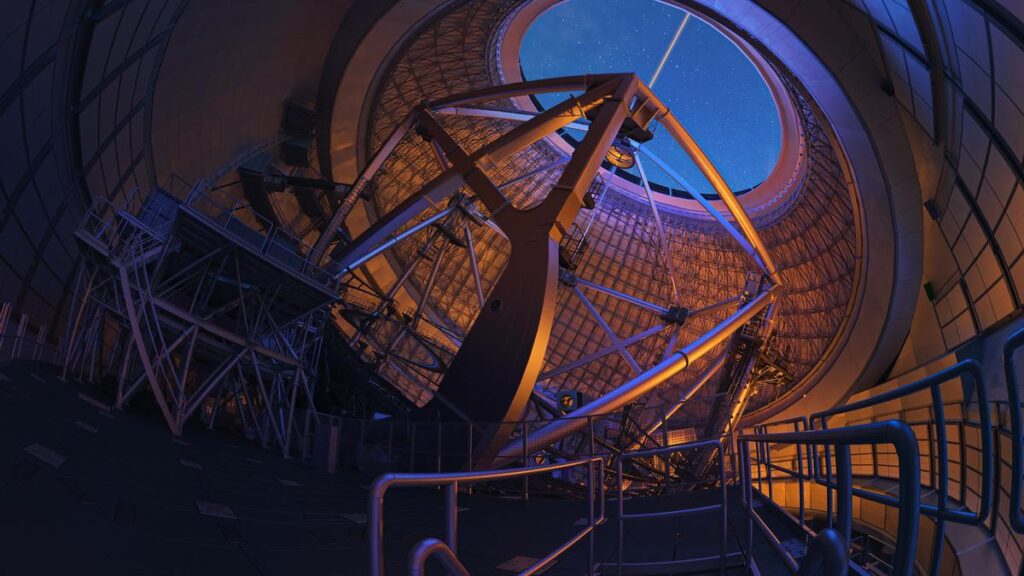
For the first time in over ten years of negotiation, Europe has joined the contest to attract the Thirty Metre Telescope (TMT) to La Palma, arguing it will “strengthen its role in global research and innovation.” The European Investment Bank (EIB) has announced its support for the project, initially by developing a strategic plan to convince the telescope’s promoters that the ‘Isla Bonita’ is the best candidate for this major scientific infrastructure.
Strategic Support from European Investment Bank
Specifically, the EIB will help steer negotiations between the TMT International Observatory (TIO) Consortium and the Instituto de Astrofísica de Canarias (IAC), highlighting the suitability of locating the telescope in Europe. An advisory team from the bank’s InvestEU Advisory Hub will produce a document identifying potential public and private investors interested in developing one of the most important scientific infrastructures of the coming decades in Spain.
“We are fully committed to supporting science and research in the Canary Islands, in Spain, across Europe and the world,” stated Nadia Calviño, President of the EIB Group, who noted that “Europe is a global technology leader and cutting-edge research in La Palma will have a major positive impact.” European Commissioner for Startups, Research and Innovation, Ekaterina Zaharieva, added that “Europe does not lead in science by chance, but by investing together,” emphasising that “the La Palma telescope demonstrates how European investment strengthens excellence and competitiveness in research.”
Momentum Builds with Spanish Backing
Valentín Martínez Pillet, Director of the Instituto de Astrofísica de Canarias, who has been personally involved in negotiations with Europe, expressed satisfaction with the agreement. “The professionalism and constructive work with the EIB has been fundamental to the progress of this collaboration,” he stressed.
This means the coveted TMT project now has the support of the Spanish state—which has promised a €400 million investment for its construction—the backing of the Canary Islands Government—which has invested €150,000 in a specific plan for international scientific diplomacy to build bridges—and now Europe with this first collaborative step.
Hawaiian Competition and Native Opposition
The TIO Consortium warmed to Spain in early November, stating it saw credibility in the Spanish government’s “generous” €400 million offer. It consequently announced it would focus efforts on establishing a negotiation pathway to create a new observatory in Spain. After verifying the Spanish executive’s serious predisposition, the consortium has begun working on a “detailed roadmap” to make the TMT a reality on La Palma. For Science Minister Diana Morant, this decision has been a boost for Spain and an endorsement of its proposal.
Despite this Atlantic shift, the American partners are not yet entirely convinced. According to the latest reports from Hawaii News, the Pacific island has not given up. Hawaiian Governor Josh Green has sent a letter to the TMT promoters insisting the telescope could still be built on the sacred mountain, albeit on a site where a telescope had previously been located. “The protests were heard, and what we have conveyed is that if we are going to do something for future generations and for the world, something that shows us the sky and helps us in the spirit of navigation, do it on a separate site that has already been used and has a smaller footprint so they can move forward.”
Despite having the Hawaiian government’s backing, the project does not have the approval of native groups, who maintain their refusal to install the large telescope on their sacred mountain. They have already gathered over 500,000 signatures against the project.
Funding Challenges and Soaring Costs
The promoters are also trying to salvage funds from the Trump Administration. The US Administration under President Donald Trump proposed in June to stop funding the giant telescope, which has been in development for nearly two decades. In its annual budget proposal for the National Science Foundation (NSF), the Trump Administration halved funding for large telescope projects, forcing a choice between the two in this phase. In this case, the White House decided to continue funding the development of the Giant Magellan Telescope.
This path is not straightforward, as the telescope’s cost has increased exponentially over the years. Although many of its components are already built, the project is estimated to need around another $1 billion to go ahead. In total, due to delays, construction costs are now estimated at $3 billion, as project manager Fengchuan Liu explained to Honolulu Civil Beat.
No post found!