
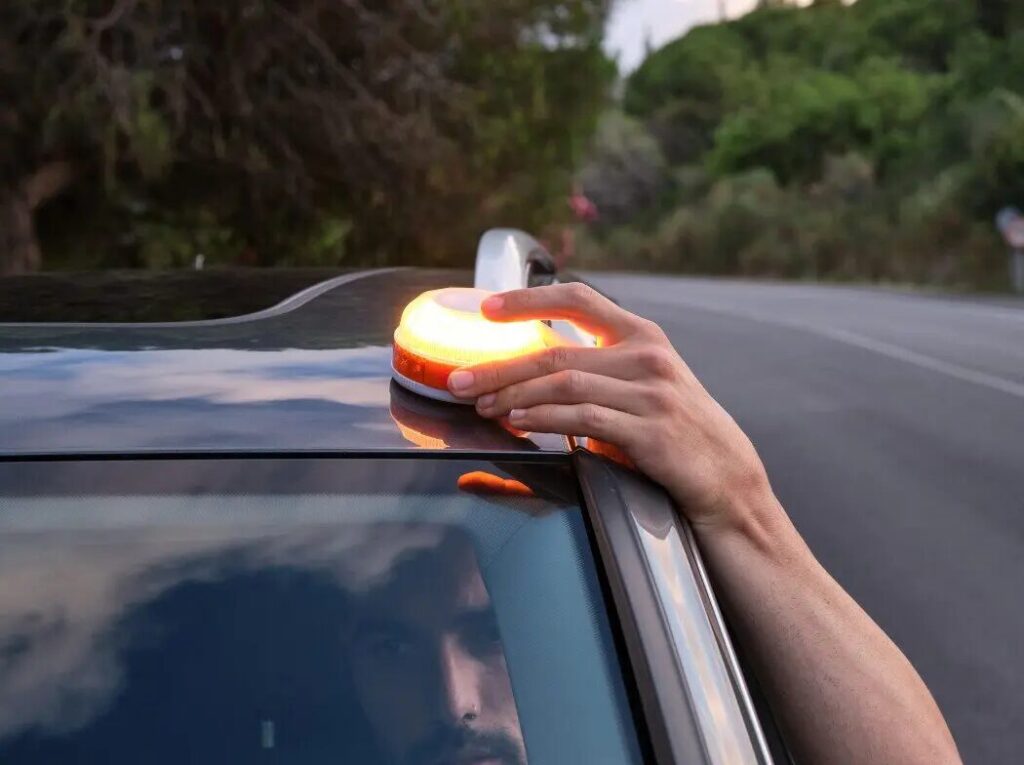
From 1st January 2026, Spanish drivers will have to say goodbye to traditional warning triangles. The Directorate General for Traffic (DGT) is introducing a revolutionary change in how broken-down vehicles are signalled on the road. From then on, the only legal way to indicate a breakdown or accident will be the V-16 beacon – an intelligent device designed to save many lives.
- Why Are Spanish Authorities Phasing Out Warning Triangles?
- What Is the V-16 Beacon?
- How Does the New Beacon Work?
- Which Models Are Approved?
- Beware of Cheap Counterfeits from Online Marketplaces
- Transitional Provisions and the New Reality
- Penalties for Not Having a Beacon
- Privacy Protection – DGT Addresses Concerns
- International Use of the V-16 Beacon
- Hire Cars and the V-16 Beacon
- Additional Changes to Road Signage
- Motorcycles and Other Vehicles – Who Needs a Beacon?
- One Device Is Enough
- A Revolution in Road Safety
Why Are Spanish Authorities Phasing Out Warning Triangles?
The statistics are alarming – every year in Spain, around 25 people are killed after leaving their vehicles to set up warning triangles. The DGT emphasises that drivers were forced to walk at least 100 metres along the carriageway or hard shoulder, often in conditions of poor visibility, at night, or during bad weather. Vehicles passing at speeds of 90, 100, or even 140 km/h created a lethal hazard.
Some countries, such as the United Kingdom, had already banned the use of warning triangles on motorways, deeming it too dangerous for drivers to leave their vehicles in such conditions. Spain has decided to go a step further and eliminate this risk entirely.
What Is the V-16 Beacon?
The V-16 beacon is a small, yellow device equipped with connectivity to the DGT 3.0 digital platform. The device emits high-intensity light in a 360-degree pattern, both flashing and continuous, for a minimum of 30 minutes. The key feature distinguishing the new generation beacon from older models is connectivity – the device automatically transmits the exact location of the broken-down vehicle to the DGT system.
The beacon contains a built-in GPS chip and a non-removable SIM card, which ensure connection to the platform. Importantly, drivers don’t need to use a mobile phone or install any application – simply switch on the device and everything happens automatically.

How Does the New Beacon Work?
Operating the device is incredibly simple. The beacon attaches magnetically to the vehicle’s roof, at the highest possible point to ensure maximum visibility. Drivers can do this without leaving the car, which is the main objective of introducing the new regulation.
Upon activation, the beacon immediately begins emitting a warning light and simultaneously sends a signal to the DGT 3.0 platform. This means other vehicles are warned both through direct visual light and virtually – the system can alert approaching drivers to the hazard.
The device is powered by an internal source – depending on the model, this may be non-rechargeable alkaline batteries or USB-rechargeable lithium batteries. The batteries or accumulators must ensure operation for a minimum of 18 months.
Which Models Are Approved?
Not every beacon labelled as V-16 meets the new requirements. For a device to be legal from 1st January 2026, it must have official homologation and connectivity enabling transmission of the vehicle’s location. The DGT recommends checking the current list of certified brands and models on the organisation’s official website.
All approved devices must be certified by IDIADA or LCOE. Each device should have a clearly marked homologation code beginning with “LCOE” followed by 12 digits, or “IDIADA PC” followed by 8 digits. The price of an approved V-16 beacon ranges between €35 and €60, depending on the manufacturer, battery life, and additional features.
Beware of Cheap Counterfeits from Online Marketplaces
Drivers planning to purchase a V-16 beacon should exercise particular caution when choosing where to buy. Devices offered on popular foreign platforms such as AliExpress or similar online marketplaces may not meet Spanish homologation requirements.
A V-16 beacon costing less than €20 should raise serious doubts about its authenticity – unless it’s an official, verified promotion. Purchasing a non-approved device means not only wasted money but, most importantly, non-compliance with regulations. Having a beacon without the appropriate DGT certificate is treated the same as not having a device at all – punishable by an €80 fine.
Moreover, millions of drivers who purchased older V-16 beacon models without connectivity in recent years will need to replace them with new, approved devices featuring geolocation. Only beacons meeting the latest technical requirements will be legal from 2026.
Transitional Provisions and the New Reality
Until 31st December 2025, drivers may continue using traditional warning triangles or older versions of V-16 beacons without connectivity. Both systems can coexist during this transitional period.
However, from 1st January 2026, the situation will change radically. Warning triangles will cease to be a legal means of signalling for vehicles registered in Spain, and their use will be prohibited. The only permitted method of signalling will be an approved V-16 beacon with connectivity.
It’s worth noting that vehicles registered in other countries travelling on Spanish roads as part of international traffic will still be able to use warning triangles.

Penalties for Not Having a Beacon
Drivers who don’t have an approved V-16 beacon from January 2026 risk an €80 fine. This is exactly the same amount that previously applied for not having warning triangles. The DGT treats this as a minor offence, but non-compliance can lead to higher penalties if appropriate vehicle signalling isn’t provided in an emergency situation.
Privacy Protection – DGT Addresses Concerns
Many controversies and false claims have emerged around the new device, particularly regarding user privacy. The DGT categorically denies that the V-16 beacon is used to track drivers or vehicles.
Spain’s Data Protection Agency has officially confirmed that the beacon is not linked to any person or vehicle registration number. All data received by the DGT is anonymous. The device transmits only the vehicle’s location and only when activated. It doesn’t record speed, doesn’t track routes, doesn’t require providing personal data upon purchase, and doesn’t need any application installation.
Users don’t need to register the device or link it to their personal data. The system operates solely for road safety purposes at the moment of breakdown.
International Use of the V-16 Beacon
The V-16 beacon is recognised by countries that are signatories to the Vienna Convention on Road Traffic, which includes Portugal, France, Germany, Italy, and the United Kingdom – approximately 86 countries across different continents in total.
The Vienna Convention states that countries may require vehicles travelling on their territory to carry a warning device in the form of an equilateral triangle or other device of equivalent effectiveness, as provided by the regulations of the country where the vehicle is registered.
However, each country has its own regulations. For example, France still requires warning triangles and a hi-vis vest – the V-16 beacon can serve as additional safety equipment there but doesn’t replace the required items. Similarly, Portugal recognises light-emitting devices, but triangles remain mandatory.
Spanish drivers travelling abroad should therefore check local regulations and, if necessary, take traditional warning triangles with them.

Hire Cars and the V-16 Beacon
People planning to hire a car in Spain may wonder whether they’ll need to purchase a V-16 beacon themselves. The answer is clear: car hire companies are obliged to equip their fleets with approved V-16 devices with connectivity.
From 1st January 2026, all car hire companies, long-term rental firms, and corporate fleet managers must ensure that every vehicle given to customers is equipped with a certified V-16 beacon connected to the DGT 3.0 platform. Legal responsibility for equipping the vehicle primarily rests with the owner or fleet operator.
However, drivers aren’t completely exempt from responsibility either. If they’re driving a car without the required device, they can be fined, even if the hire company failed to fulfil its obligations. Therefore, when collecting a hired vehicle, it’s worth checking for the presence of a V-16 beacon and ensuring it’s approved – a certification number should be visible on it.
Hire companies are also obliged to inform customers in writing about the requirement to have a beacon and instruct them on how to use it correctly. Major hire chains have already announced that their fleets will be fully prepared for the new regulations coming into force.
Additional Changes to Road Signage
Besides introducing the mandatory V-16 beacon, Spanish authorities are working on broader modernisation of the road signage system. The government approved an update to the official catalogue of road signs, which came into effect on 1st July 2025.
This reform aims to adapt signage to social, technological, and mobility changes. New signs are being introduced to regulate the movement of alternative means of transport, such as e-scooters and other personal mobility vehicles. Pictograms are being redesigned, sign visibility is being improved, and some outdated markings are being eliminated.
The new catalogue also incorporates principles of sustainable development and inclusive visual language. The change of physical signs on roads will be carried out gradually to give drivers time to adapt to the new symbols.
Motorcycles and Other Vehicles – Who Needs a Beacon?
The obligation to have a V-16 beacon applies to passenger cars, dual-purpose vehicles, goods transport vehicles, and buses, in accordance with Annex XII of the General Vehicle Regulations.
For motorcycles, the beacon isn’t mandatory, but the DGT recommends using one due to safety benefits. Thanks to the magnetic base, the device can be attached to the fuel tank, seat, luggage box, or mirror stem.
Particularly important is that vehicles carrying dangerous goods are subject to the V-16 beacon requirement for strict safety reasons.

One Device Is Enough
Regulations require having one V-16 device per vehicle. There’s no legal obligation to have several beacons, although some drivers may decide to keep a spare device for peace of mind.
The beacon should be stored in a compartment, easily accessible and charged. The device must guarantee connectivity until 2038 according to regulations, and if it doesn’t meet this requirement, it will no longer be considered valid.
A Revolution in Road Safety
Replacing warning triangles with the intelligent V-16 beacon represents one of the biggest changes to road safety regulations in recent decades. This isn’t just technological modernisation but, above all, preventive action aimed at protecting human life.
The new regulation will allow drivers to remain inside their vehicles without exposing themselves to danger from traffic, whilst ensuring their position is visible and digitally registered in the traffic management system.
This obligation covers all of Spain, including popular tourist regions. Drivers in the Canary Islands, on both Tenerife and Gran Canaria, Lanzarote, and Fuerteventura, will also need to have an approved V-16 beacon in their vehicles. Tourists hiring cars in Tenerife or Gran Canaria can expect that vehicles from hire companies will already be equipped with the required devices.
The DGT emphasises that the change isn’t a technological whim but a priority safety measure. Spanish drivers have little time left to adapt their vehicles to the new requirements before the end of 2025. It’s worth acting now to avoid fines and, most importantly, to increase your own safety on the road.