
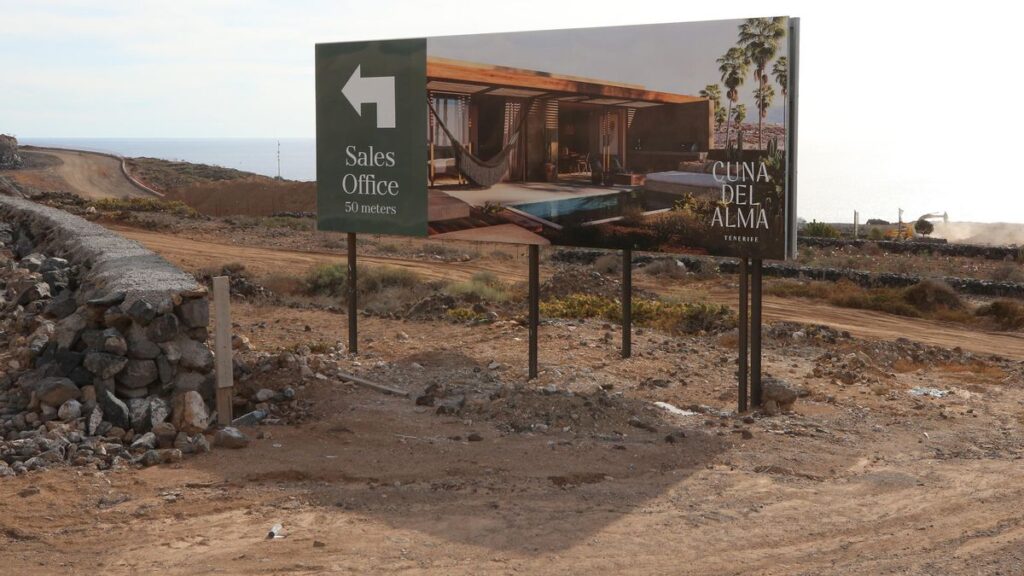
Government Approves Coastal Construction for Luxury Tenerife Project
The Government of the Canary Islands has permitted the developer behind the controversial Cuna del Alma tourism project in Puertito de Adeje, south Tenerife, to occupy a coastal protection zone to build an open-air swimming pool and a restaurant. The authorisation was granted on the grounds that the development is beneficial for the Canary Islands’ tourism-based economic model. This is detailed in a resolution from the regional government’s Directorate for Coasts and Maritime Space Management, accessed by Canarias Ahora.
Internal Report Contradicted Final Decision
The directorate, part of the Public Works, Housing and Mobility Ministry led by Pablo Rodríguez (Coalición Canaria), ultimately sided with the developer’s arguments. This was despite an internal report from July 2024 which acknowledged that both structures—along with other leisure facilities in the complex like a buggy park—could be located outside the protected coastal strip, where uses are highly restricted, and do not provide a necessary or convenient service to the public maritime-terrestrial domain.
Months later, the project promoter, the company Segunda Casa Adeje SL, filed an appeal. It argued firstly that the pool qualified as an uncovered sports facility, a legally permitted use in the protection zone. Secondly, it claimed the restaurant was a convenient addition to offer hospitality services at Puertito de Adeje beach, which it described as small and unable to meet summer demand. The company stated the existing facilities were “clearly insufficient” and that including the proposed amenities was “convenient” for providing a better service to the public coastal domain.
Coastal Authority Sides with Developer
The Canarian government quickly agreed. On 30 January 2025, the director of Coasts and Maritime Space Management, Antonio Acosta, authorised the Cuna del Alma works on plot T2 of the plan, a tourism-use plot covering some 45,000 square metres. Of this, 5.25% (nearly 2,400 square metres) lies within the coastal protection strip. Acosta adopted the promoter’s arguments point by point, also citing other rulings that shelter behind “the relevance of tourism for the Canary Islands’ economy,” noting that “hospitality facilities are very important for leisure activities on the coast and beaches all year round.”
Prosecutor Challenges Authorisation and Calls for Review
This coastal resolution was one of the documents used by the judge of Court of First Instance Number 1 in Arona to dismiss the criminal case against Cuna del Alma several weeks ago. The magistrate considered that the various actions comprising the controversial project had the pertinent administrative authorisation to continue. However, the Public Prosecutor’s Office has appealed the dismissal, calling into question precisely the authorisation concerning the occupation of the protection zone.
The prosecutor finds it difficult to accept that the open-air pool and restaurant cannot have another location, or that they provide a service for the use of the public maritime-terrestrial domain. The prosecutor has requested the complete file for the resolution and an independent expert report to analyse whether both structures meet the strict criteria for construction in that coastal strip. These criteria, established by the General Coasts Regulations, are limited to activities that by their nature cannot be located elsewhere, those that provide necessary or convenient services for the use of the public domain, and uncovered sports facilities.
A Controversial Path Through “Positive Administrative Silence”
The authorisation procedure for this plot partly encapsulates Cuna del Alma’s controversial journey to date. The promoter requested permission from the regional government to build on it in February 2022, as a small part was located in the protection zone and therefore required special clearance. At that time, Decree 171/2006 was in force in the archipelago, stating that the maximum period for responding to such authorisation requests was six months. If there was no response, the request was deemed approved—a mechanism known as “positive administrative silence.”
The regional government’s time to respond expired on 23 May 2023. The promoter obtained a green light without receiving explicit approval. A year later, in 2024, the Canarian government repealed Decree 171/2006 and approved a new one, 45/2024, which changed the nature of administrative silence from positive to negative for these procedures. It did so to prevent transferring powers to applicants or third parties that could affect the public maritime-terrestrial domain and involve activities “that could irreparably damage the environment or be very costly to repair”—implying the previous regulation may have harmed the coast through positive silence.
From Technical Objection to Legal Justification
Also last summer, the Directorate General for Coasts issued its first technical report on Cuna del Alma’s request. It noted that the proposed uses (the pool, restaurant, buggy park) “could have another location outside the protection zone and do not provide a necessary or convenient service to the public maritime-terrestrial domain.” The same document also found that some of the project’s retaining walls exceeded three metres in height, breaching regulations.
The promoter appealed. It defended the legality of the positive silence, justified the suitability of the proposed works by citing rulings that position restaurants as perfect complements for better beach enjoyment, and assured it had corrected the wall heights. In January of this year, the head of the Eastern Coastal Planning Service, Valeriano Díaz, signed a legal report proposing to authorise the occupation of the plot, adopting the thesis of Segunda Casa Adeje SL. Díaz also argued for ensuring “[Canary Islands beaches] are equipped with this type of service,” a service offered to both complex clients and the general public.
Finally, on 30 January 2025, Antonio Acosta authorised the works with a two-year execution period. Earthworks within the coastal protection zone for Cuna del Alma have been reported by environmental groups, who maintain that not only plot T2 but also plots T1 (tourism use), CO-4 (commercial-leisure), and RD-1 and RD-2 (recreational-sports) are affected.
No post found!