
A Subterranean Paradise Beneath Tenerife
Tenerife’s natural spaces boast exceptional beauty. Its beaches, mountains, native flora, cliffs, and volcanoes have made the island a paradise for visitors. Yet there are others, equally beautiful though more hidden, which guard within their depths the history of an island shaped by volcanic eruptions. A prime example is the Cueva del Viento in Icod de los Vinos, notable not only for its physical characteristics but for everything it contains within.
Europe’s Largest Volcanic Tube
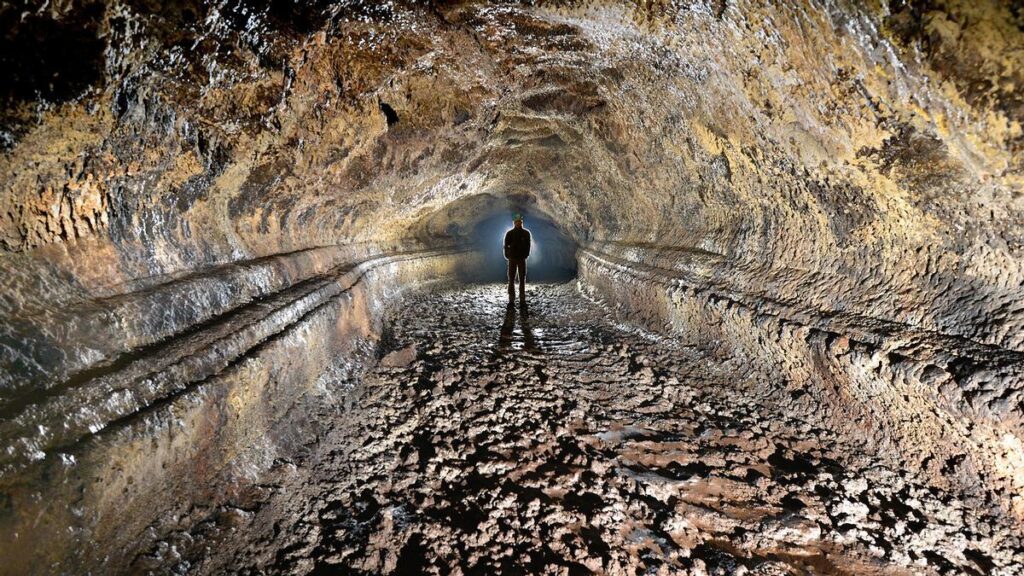
The Cueva del Viento is a unique space in Europe, thanks to its volcanic tube. With 18.5 kilometres currently mapped, it holds the title of the sixth largest in the world—the others are in the Hawaiian archipelago—and the largest in Europe. However, although not officially confirmed, some speleologists suggest its total length could be around 50 kilometres. With these credentials, it’s no wonder the Cueva del Viento has become an essential visit for many. But beyond its physical stats, understanding its origins is key.
Born From the Fire of Pico Viejo
Esther Martín González, curator of Palaeontology and Geology at the Museum of Nature and Archaeology (MUNA) and scientific lead for the Cueva del Viento, explains to this newspaper that it was formed around 27,000 years ago from lava flows during eruptions of the Pico Viejo stratovolcano. “Two of the most important factors for generating volcanic tubes are a certain slope and fluid lava,” she states. In this case, both converged to create this cave of special relevance in Icod de los Vinos. The expert clarifies that the origin is likely due to “several eruptions within a short period of time,” which would have created different levels within the Cueva del Viento system.
A Labyrinthine Network of Galleries
The cave’s interior is a testament to how those eruptions transformed the landscape, creating a vast, maze-like network of underground passages leading to different galleries and caves. The visit begins at the known entrance, or ‘jameo’ (a natural entrance to volcanic tubes), of Sobrado Superior and follows the visitable section, explains Martín. This space connects to a conservation zone with restricted access, where most of the species characteristic of the area are found.
Subsequently, visitors reach the Sima de la Vieja, a vertical gallery 17 metres deep. A curiosity of this space is that it is the cave’s only vertical gallery, as the rest are horizontal. From the bottom of this shaft begins what is known as Sobrado Inferior, a gallery about three kilometres long heading north, which reaches the neighbourhood of El Amparo.
A Surprisingly Modern Geological Wonder
Another curiosity of the Cueva del Viento’s volcanic tube is that it is younger than it looks. Its coloration, caused by filtrations from the outside, makes the space appear aesthetically older than it really is, explains Esther Martín. However, she clarifies, a tube of 27,000 years is “very modern.” In this sense, it must be considered that in the Canary Islands there are volcanic tubes over 300,000 years old that are very well preserved. “A one-million-year-old volcanic tube is usually quite well preserved,” adds Martín.
A World-Class Geological Phenomenon
With all these characteristics, it’s normal for the Cueva del Viento to be one of the most important globally. But it is also significant, geomorphologically speaking, for being a maze cave with at least three storeys of interconnected galleries forming a labyrinthine network, “something that is not very common,” states the expert. “The Cueva del Viento occupies a large underground area and, furthermore, at different heights, which makes it practically unique worldwide,” she adds.
Planning Your Visit
Visits to the Cueva del Viento are regulated through the website cuevadelviento.net. Specifically, 200 metres of the existing 18.5 kilometres can be visited—a small sample that allows an understanding of the ecosystem both inside and outside the volcanic tube. All visits are conducted in small groups of 15 people with an interpretive guide. This way, attendees can experience, in approximately two and a half hours, what it means to venture inside a volcanic tube. The Cueva del Viento is a Special Area of Conservation within the European Network, and its Master Plan for Use and Management is currently being updated and adapted to the current situation and reality of the area.
No post found!