Science Meets Tourism in the Canary Islands
The Canary Islands are strategically positioning the scientific research conducted across the archipelago as a unique selling point for their tourism industry. Through collaborative projects with leading scientific institutions, the region aims to enhance its appeal, stand out from competing destinations, and simultaneously improve the conservation and regeneration of its precious natural spaces. This strategic direction was highlighted by the Ministry of Tourism and Employment during the third “Journey to the Decarbonisation of the Canary Islands Destination” forum, an event dedicated to showcasing programs designed to promote sustainability within the islands’ vital tourism sector.
A Growing Tourism Sector with a Shrinking Footprint
Remarkably, the push for sustainability is yielding tangible results. Over the last five years, the number of tourists visiting the Canary Islands has surged by 16.5%, from 15.1 million in 2019 to 17.6 million in 2024. Despite this significant growth, the carbon footprint has not only failed to increase proportionally but has actually been reduced. In essence, the islands are welcoming far more visitors, yet they are polluting less.
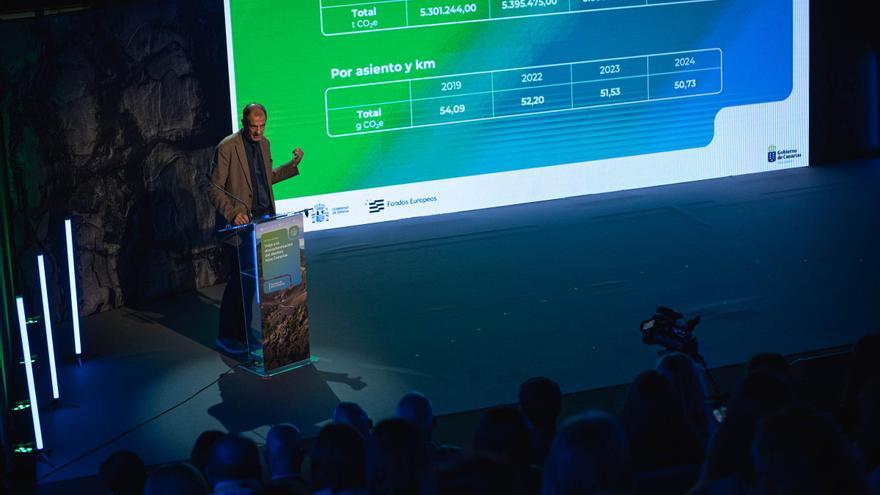
In 2024, total emissions linked to the tourism sector reached 1.7 million tonnes, an 8% decrease compared to 2019. When calculated per visitor, the carbon footprint shows an even more impressive decline of 22%, settling at just 98 kilograms of CO2 per tourist. This trend is also visible in aviation emissions. While total CO2 emissions from all flights to the Canaries (including resident travel) reached 6.2 million tonnes, this figure did not increase at the same rate as the number of flights. The carbon footprint per seat and kilometre travelled improved from 54 grams in 2019 to 50.7 grams last year.
From Sustainability to Regeneration
The journey toward a greener future is only accelerating. Councillor Jéssica de León emphasised that the sector must look beyond mere sustainability models and begin investing in the active regeneration of the territory. To facilitate this, the archipelago will launch Regnext, a public-private collaboration fund that allows administrations, businesses, organisations, and even visitors to direct resources toward environmental recovery projects.
“The profile of the visitor has changed; now they want to contribute,” detailed the councillor, noting that 58% of tourists want to “compensate, get involved, and be told what we are doing right.” This regenerative model will be key to channelling this shared responsibility. Mariano Hernández Zapata, Councillor for Ecological Transition and Energy, added that combating climate change is not just an environmental issue but an economic one, as its effects on the archipelago “could cause us to lose a significant market share” in tourism.
Six Groundbreaking Scientific Projects for Tourism
A cornerstone of this new approach is a partnership with the scientific community. As José Juan Lorenzo, Managing Director of Tourism of the Canary Islands, explained, this collaboration is a “win-win,” leveraging research to enhance both tourist experiences and natural conservation. This year, a formal agreement was signed with the Spanish National Research Council (CSIC) and the public universities of the Canary Islands, engaging 63 researchers across six pioneering projects focused on “blue tourism.”
Virtual Volcanic Expeditions
Presented by Rayco Marrero, a senior specialist from the Geological and Mining Institute of Spain (IGME), this project is identifying 50 volcanic sites across the islands. Using virtual reality, it will recreate past eruptions and ancient landscapes. “We will describe and explain these places to tourists and the public through immersive and virtual reality experiences to bring scientific knowledge closer to everyone,” Marrero detailed.
Tackling Marine Litter
Another project analyses the composition and origin of marine debris to pinpoint waste generated by tourism. Javier Hernández, Professor of Analytical Chemistry at the University of La Laguna (ULL), stated that this research will identify “pollution hotspots on the archipelago’s beaches,” enabling targeted actions to mitigate or eliminate them.
Blue Biotechnology for Health and Wellness
This initiative has exciting applications for health and wellness tourism. Researchers from the Institute of Natural Products and Agrobiology (IPNA-CSIC), the Spanish Institute of Oceanography, and ULL are studying the potential of marine microorganisms to develop bioactive ingredients sustainably. “The goal is to establish the Canary Islands as a benchmark for blue biotechnology,” said José Javier Fernández, a researcher and Professor of Organic Chemistry at ULL.
Beach Minerals as Climate Allies
Jesús María Arrieta, Director of the Canary Islands Oceanographic Centre, is working on a project that searches the archipelago’s beaches for minerals that can help combat climate change. Materials like olivine can act as carbon sinks, protect coastal biodiversity, and even “turn some areas into a kind of climate refuge for organisms suffering from ocean acidification.” The study of pollution-sensitive microorganisms will also help determine the water quality of the islands’ beaches.
The Sound of the Sea
This project allows tourists to hear the sea’s symphony without getting wet. By installing nine listening stations equipped with hydrophones, “we will be able to reveal if, while they are bathing, a grouper has brushed past them unseen, or if there are dolphins or a baleen whale nearby,” explained Jesús Alcazar, a biologist from ULL. This non-invasive technique is also highly valuable for scientists to identify species and study their behaviour.
Studying the Planet’s Water Quality
The final project, “Canary Islands: A Benchmark for the Study of the Planet’s Water Quality,” aims to analyse water temperature and the impact of climate change on the archipelago’s coasts. Eugenio Fraile, Scientific Vice-Director of the Spanish Institute of Oceanography, argued that these collective projects provide the knowledge modern tourists are already demanding. “They want to know why the beaches in the Canaries have black sand, what you can hear under the sea, and how the volcano erupted. Without science on our side to provide that knowledge, we couldn’t offer it,” he said, affirming that this gives the destination a critical added value over its competitors.
The forum continued with further discussions on climate innovation, sustainable aviation fuels, and other successful projects committed to the long-term sustainability of the Canary Islands.