
President Condemns New Airport Charges
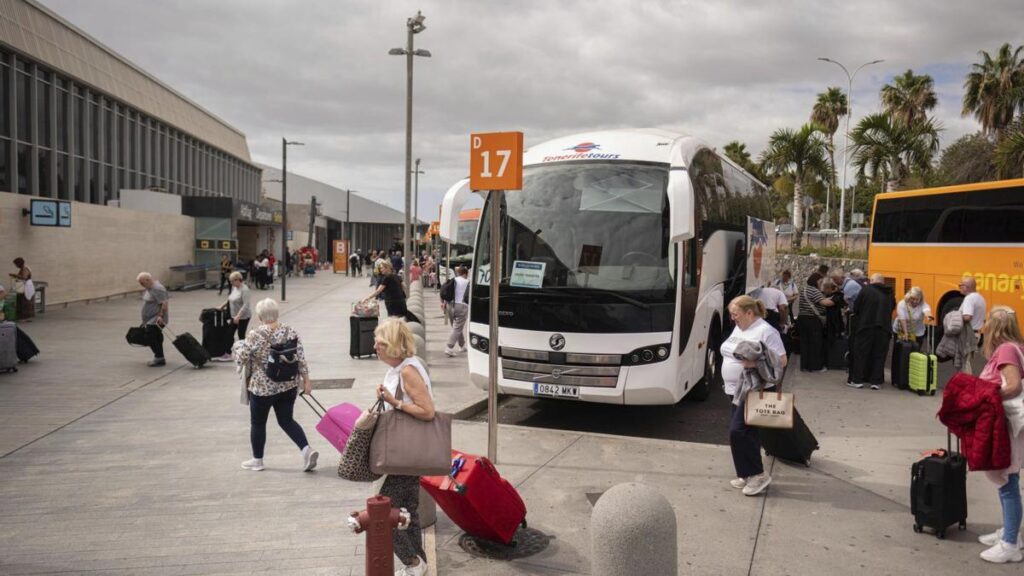
The President of the Canary Islands, Fernando Clavijo, stated on Wednesday that decisions like the new charge for buses at airports, imposed by airport operator Aena, will “reduce the sector’s competitiveness”. He described it as another example of a “policy of increasing revenue” that the Spanish state and Aena would maintain “at all costs”, while Canary Islands airports continue to suffer from “a significant deficit” in their infrastructure.
President Clavijo made these remarks in an interview with Radio Canaria, reported by Europa Press, where he lamented what he called the “crazy spending” in which the state is currently engaged, trying to “find income from all sides”. “In any case, we would think it was fine if it had a direct impact on improving our airports, but if they are going to take it to fix (the airport at) El Prat in Barcelona…”, he suggested.
Infrastructure Deficits and Passenger Queues
Clavijo recalled that in contrast to this new Aena policy, which “reduces the sector’s competitiveness”, Canary Islands airports suffer from “an important deficit” in infrastructure, with “enormous” queues and poor conditions at these airfields, for example, in passport control. “To take the profits and cover Aena’s expenses, for that they do raise fees and look for new taxes…”. “All of this reduces the sector’s competitiveness, and in any case we would think it was fine if it had a direct impact on improving our airports, but if they are going to take it to fix El Prat, in Barcelona…”, he stated.
Aena’s Justification for the New Fee
Aena clarified on Tuesday that the establishment of a charge for buses at Tenerife South and César Manrique-Lanzarote airports is due to limited space and a significant growth in the number of private hire vehicles in recent years. The operator also believes it will discourage the “incorrect use” of the car parks.
Sources from the airport manager explained to Europa Press that it has become “necessary” to reorganise the car parks designated for buses and noted that the measure is already in place at other airports in the network, such as Palma de Mallorca.
How the New Charging System Will Work
Aena detailed that this new model will begin on 15 January at Tenerife South and César Manrique-Lanzarote airports. It will include a barrier access system and a pay-on-exit method, with 60 minutes of free grace period for passenger pick-up. If this hour is exceeded, the full stay must be paid at the general car park’s hourly rate, the sources specified.
However, they pointed out that a progressive transition period has been established until 15 April—once the Easter period and the winter season have concluded—with wider grace periods.
Managing Limited Space and Future Rollout
According to the airport manager, the space designated for buses at airports is a “privileged” location close to the terminal and must have an “agile” operation, without prolonged parking, to avoid blocking the scarce available space and to facilitate use by all transport companies that require it. The sources therefore state that a “sufficiently wide” grace period has been established to allow for the loading and unloading of passengers completely normally.
With this measure, they indicate, the infrastructure is adapted to current demand, improving operability and regulating car park capacity, allowing for a higher turnover that accommodates all users. Following Tenerife South and Lanzarote, Aena’s intention is for the measure to also be applied in the high-occupancy vehicle car parks at Gran Canaria and Fuerteventura airports.
No post found!