The Growing Drone Threat and the Security Response
The rising threat posed by drones has introduced a new factor of insecurity, leading to the development of increasingly advanced and sophisticated counter-drone systems. Due to its geostrategic location, the Canary Islands are not immune to this phenomenon. Both the Spanish Armed Forces and State Security Forces are now equipped with teams dedicated to detecting, neutralizing, and jamming these devices when they fail to comply with regulations or pose a security threat.
Military and Police Anti-Drone Units
Existing security systems in the Islands include the Civil Guard’s Pegaso unit, the National Police’s Air Resources Unit, and the Air Force’s C-UAS (Counter-Unmanned Aircraft System). These units work to monitor and control the airspace against unauthorized drones. Last September’s “Eagle Eye” maneuvers served as a major training exercise, bringing together the Air Force, police forces, and other military branches like the Navy and the Army. A key novelty in this edition was the incorporation of anti-drone response systems.
The Challenge of Small Drones
A primary objective was to refine the coordination of defense systems against small drones, which are particularly difficult to detect and neutralize. Even without hostile intent, these devices can endanger airports and other critical infrastructure, as has already occurred at the Gran Canaria and Fuerteventura airports. The presence of drones has multiplied exponentially in recent years for commercial, professional, filmmaking, security, infrastructure, and surveillance purposes. Military and intelligence use has also surged following conflicts like the war in Ukraine, prompting a European-wide response to strengthen systems against this threat.
How Anti-Drone Systems Work
The National Police and Civil Guard have had anti-drone systems deployed in the Islands since 2021. Over the past four years, the devices used to monitor airspace have been expanded and refined, capable of both geolocating drones and jamming their signals if they are deemed a threat. Inspector Juan Seguí of the National Police Air Resources Unit explains that it’s not just about detecting a drone and tracking its trajectory, but also about locating the pilot controlling the device. Before neutralizing and jamming the drone’s signal, they first attempt to identify the pilot and have them land it, provided they are operating within the law. “If we consider it a threat to people or property, we can intercept and neutralize it with our equipment,” the police officer adds. The goal of these systems is not to destroy the drones but to intercept their flight configuration or GPS signal and, if necessary, neutralize them so they hover without a signal and land without creating additional risk.
Strict Regulations for Drone Operators
The regulations and requirements for owning and piloting a drone are extensive and exhaustive at both the European and national levels. In the EU, the European Union Aviation Safety Agency (EASA) is the regulating body, while in Spain, it is the State Aviation Safety Agency (AESA). Operators must possess a pilot’s license, be registered with these agencies, have insurance, and notify the Ministry of the Interior via its electronic office so that state security forces are aware of their activities. This applies to anyone using a drone for professional work, image capture, recreation, or any other purpose, especially if flights are conducted in urban areas, over crowds, restricted zones, or protected natural spaces. “Anyone who has a drone, even for private use, that exceeds 250 grams and has a camera must be registered with AESA. This also applies to drones below that weight if they have a camera or can capture images,” warns Inspector Seguí. Only toy drones without cameras are exempt.
Deployment at Major Events and Critical Sites
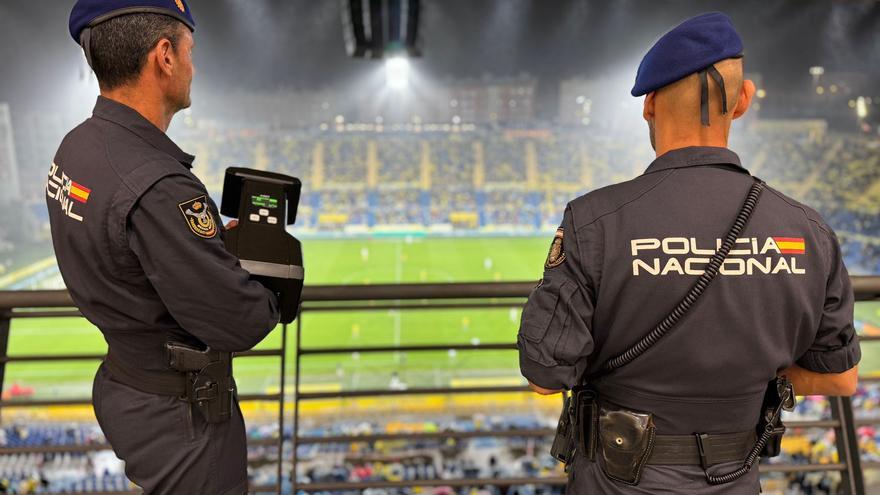
Since their deployment began in 2021, there has been an “exponential” increase in anti-drone operations in the Canaries. These systems have become a standard part of the security apparatus for massive sporting, religious, and civil events, including First and Second Division football matches, the protection of high-ranking personalities, and the surveillance of strategic infrastructure. This includes airports, ports, heliports, military installations, industrial zones, areas of high economic value, and specially protected natural spaces.
Real-World Operations
Sergeant First Class Lorenzo Negrín of the Civil Guard’s Pegaso unit detailed the system’s use during the last procession of the Virgen del Pino to the capital of Gran Canaria, the Rally Islas Canarias, the Transgrancanaria hiking event, and the visit of the training ship Juan Sebastián Elcano with the Princess of Asturias on board. Both the National Police and the Civil Guard collaborate in protecting members of the Royal Family and during recent visits by Chinese officials, who often stop in the Canaries. In these cases, the authorities’ security teams bring their own systems, and local forces collaborate to provide complementary security.
Protecting the Skies Over Airports and Military Bases
The Pegaso unit was established in 2019 and arrived in the Canaries in 2021, with its own facilities in the Gando area between the Airport and the Air Base. According to Negrín, the anti-drone system is one of the elements used for the “proper use of airspace” in collaboration with the air navigation manager, Enaire, and the airport operator, Aena. Airports have their own protocols for when drones invade airport airspace, and in such cases, they request assistance from the Civil Guard. Sergeant Negrín recalled the incident at Fuerteventura airport, warning that “paralyzing airport operations is a very serious matter, and the fines are substantial.” The Gando airport facility has also been affected by such devices.
A Strategic NATO Installation
The Gando Air Base, a strategic military installation for both Spain and NATO, has been equipped with its own anti-drone or C-UAS system since September. This system enables the neutralization of drones that pose a threat to the security of both military and civilian air operations. With this deployment, the Air and Space Army aims to enhance the reaction capability already possessed by the Armed Forces and police in the airspace of both the military base and Gran Canaria Airport. The Gran Canaria airfield handles the most air traffic in the Canaries, ranking fifth in flight operations and sixth in passenger numbers. Any threat that disrupts its normal operation has a significant impact on both safety and economic cost.
Naval and Army Capabilities
The system installed at Gando Air Base consists of two subsystems: the first can detect and neutralize a drone in flight and locate the pilot’s position. The second subsystem is dedicated exclusively to neutralizing the drone, acting directly on the aircraft once it is located by electronic or visual means. The Navy has also installed anti-drone technology on its ships. The system used on vessels is the DroneDefender V1LF by SDE-Defense, which uses combined hardware and software to detect both friendly and enemy drones. The hardware is composed of modular, scalable equipment that is easy to install. The Army in the Canaries has anti-aircraft defenses against traditional aircraft but not specific anti-drone systems, although they deploy such equipment during maneuvers to train with these technologies.