A Living Window Into the Past
In a remarkable discovery that rewrites ecological history, scientists working on a reforestation project in Teide National Park have identified 11 Canary Island cedar trees exceeding 1,000 years of age. Three of these ancient giants are over 1,500 years old, with eight surpassing the millennium mark. This incredible find confirms the historical existence of a vast cedar forest in the Las Cañadas caldera. The prospecting and carbon-14 dating work, which began in 2019 and expanded through 2025, has now dated 25 specimens in total.
Located in nearly inaccessible areas, these trees “represent a unique window into the national park’s ecological past and reinforce the value of the Canary Island cedar as a symbol of resilience, biodiversity, and environmental memory,” explains José Luis Martín Esquivel, one of the project biologists.
Meet Tara, Europe’s Oldest Living Tree
The crown jewel of the discovery is a cedar named Tara. At 1,544 years old, this fertile, fruit-bearing tree has officially been crowned the oldest living tree in Europe, dethroning the previous record-holder. While its age was suggested years ago, its official naming was celebrated this week.
“It’s feminine, so we decided to call her Tara,” said climber Javier Martín Carbajal, one of the individuals who discovered this specimen. He and three others are responsible for scouring the park’s steep cliffs in search of more cedars. Tara clings to a wall of the Roques de García at a height of 150 meters. “You won’t find it,” Martín Carbajal laughed, referring to its extreme inaccessibility.
The Tenerife conservationist, with 40 years of climbing experience in the park, once told park biologist José Luis Martín Esquivel that he knew of a cedar that was probably older than ‘El Patriarca,’ another cedar dated at 1,118 years. Upon seeing Tara, Martín Esquivel could only say, “It’s like an open book waiting to be read,” Martín Carbajal recalled.
A Collaborative Conservation Triumph
The analysis of Tara is part of a larger reforestation and conservation project led by the Tenerife Island Council (Cabildo) in collaboration with the Endesa Foundation and the University of Valladolid. At a results presentation at the Teide El Portillo Visitor Center, it was revealed that the initiative has already led to the planting of 17,000 new cedars.
Juan Ignacio Ferrer, Head of Biodiversity at the Endesa Foundation, stated, “At the Endesa Foundation, we work to conserve natural heritage through biodiversity projects alongside national parks.” He emphasized that restoring the cedar groves in Teide National Park “is a unique opportunity to restore nature’s balance and recover a landscape as valuable as that of Teide.”
Professor José Miguel Olano from the University of Valladolid added, “This discovery demonstrates how applied science and public-private cooperation can deliver tangible results in protecting natural heritage. Canary Island biodiversity is a treasure we must protect with determination.”
Saving Other Native Treasures
The conservation efforts extend beyond the cedar. A second project with the Endesa Foundation and Agroforestal has successfully reintroduced 65 Teide violets (Viola cheiranthifolia) and 50 silver thistles (Rhaponticum canariense) into two new locations within the park.
Martín Esquivel noted that the most threatened species now number in the several thousands. “However, they are still at risk, though not facing extinction,” he clarified. The Teide violet, primarily located on Mount Guajara, came dangerously close to being wiped out by the fires that ravaged the south of the island in 2023. “That led us to urgently seek a second location to prevent a single event from ending the species. We now have a second population in the ‘sombrerito de Chasna’,” the biologist described.
Regarding the silver thistle, a species that “a few decades ago was one of the most threatened in the world, with fewer than 200 known specimens, we now have several thousand.” However, a new challenge has emerged: “At the highest altitudes, the species is beginning to suffer from climate change. Therefore, we established a new colony at a higher location on the slopes of Teide, at about 2,800 meters, which guarantees its survival.”
The Meticulous Magic of Regeneration
The project’s success hinges on a meticulous process that begins with seeds. Ángel Mallorquín, coordinator of the initial phases, explained that searching for and separating seeds is a arduous and time-sensitive task. “Each one has its own process. There isn’t a single formula for all; each has its particularity, so the process varies depending on the seed.”
One clever way to speed up the process is to collect seeds from bird droppings. “In the case of the cedar, we have the fieldfare, which comes from Northern Europe. It eats the fruit and disperses the seed. This way, we advance the process by six months,” estimated Martín Esquivel.
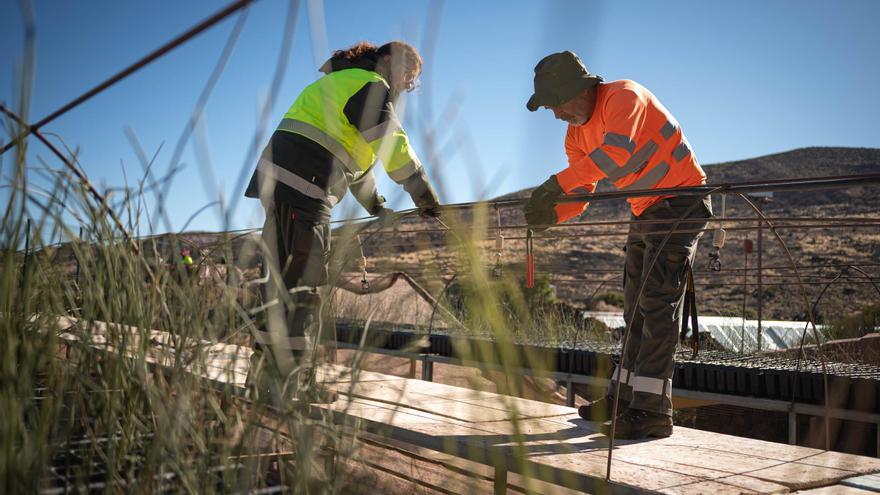
After the seed bank comes the nursery, described as “the seed daycare.” Once the plants are juveniles, they undergo an acclimatization phase where they are exposed to the park’s harsh conditions. Finally, they are returned to their original sectors protected by fences to prevent herbivores from eating them.
As for Tara’s reign as the oldest, climber Javier Martín Carbajal announced that more specimens in Teide National Park are still awaiting analysis, so her title may yet be challenged. The search in the island’s rugged heart continues, revealing living chapters of an ancient ecological story.