
AI Makes Its Way into Canarian Classrooms
As in many other areas of daily life, Artificial Intelligence (AI) is now finding its way into classrooms across the Canary Islands. Schools and educational authorities are currently reflecting on the use of these tools at early ages and are opting to use the technology solely to provide educational resources for teaching staff. The use of these platforms for younger students is not yet on the agenda. “First we must work with the teachers, and only then can we introduce AI to the pupils,” state experts from across the country.
A Coordinated and Cautious National Approach
This approach is shared by different Spanish regions, which are coordinating the implementation of AI through the National Institute of Educational Technologies and Teacher Training (INTEF). A key priority for the education authority is to create a safe space to use Artificial Intelligence in classrooms while mitigating potential drawbacks of this new tool. The Canary Islands Government’s Department of Education has already published an AI guide featuring ethical guidelines for its use, based on reports drawn up by the European Commission in 2022.
Safety, Ethics and Teacher Training Take Priority
Safety, ethics, inclusivity, and responsibility are the aspects the Department of Education insists must not be overlooked with the arrival of AI in schools. This is why different approaches are being established, depending on whether the use of these tools is intended for teachers or students. In any case, the former is currently more developed in the Canaries.
Ivonne Rodríguez, Coordinator of the Educational Technology Area for the Canary Islands Government’s Department of Education, indicates that AI can establish itself as a professional tool for teachers. Therefore, the department overseen by Councillor Poli Suárez is already developing the Plan for Digital Education in the Canary Islands in the 21st Century. This includes integrated measures so classroom professionals can introduce technology into the learning process while receiving training and support themselves.
The technician acknowledges that for just over a year there has been high demand from teachers to access these AI-focused courses, and confirms they will certainly continue to be offered in the coming years. Currently, AI tools are entering Canarian classrooms solely as support for generating educational resources that can be adapted to different educational levels and student learning paces, though “always bearing in mind human supervision,” Rodríguez warns. She also stresses the importance of guaranteeing student data protection.
Preparing Students for a Future with AI
From the student perspective, the challenge is to prepare them to coexist with Artificial Intelligence tools in a critical, ethical, and safe manner. To this end, the Canary Islands is focusing on teaching computational thinking. This helps young people understand that AI is nothing more than a combination of algorithms, data, and patterns, and that it can also make mistakes. This training is delivered at different educational levels, from Infant school to Vocational Training, with programmes like ‘School Code 4.0’ which develops digital competence, computational thinking, and robotics. More advanced courses propose specific subjects with greater challenges.
AI in Action: A Gran Canaria Primary School Case Study
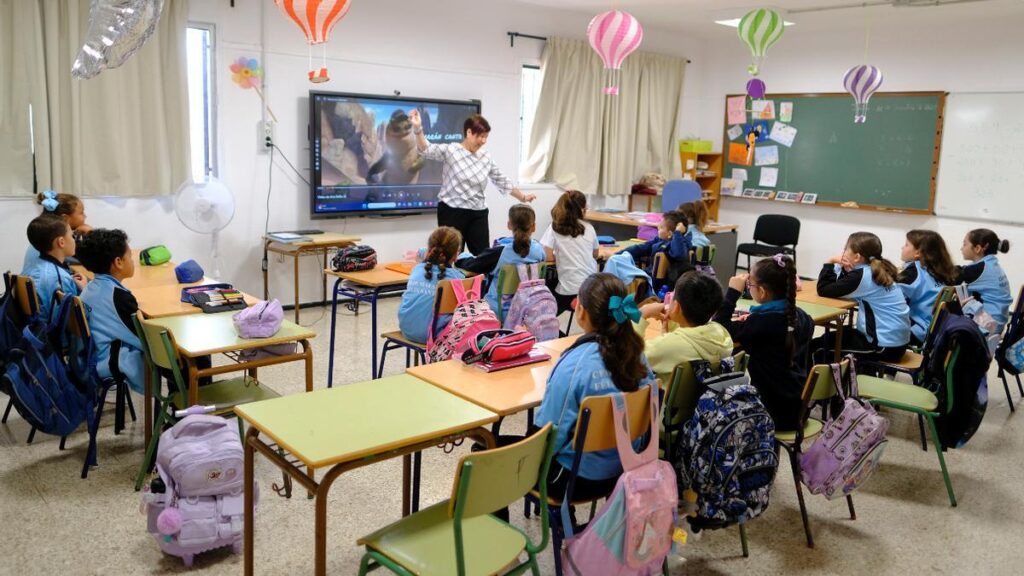
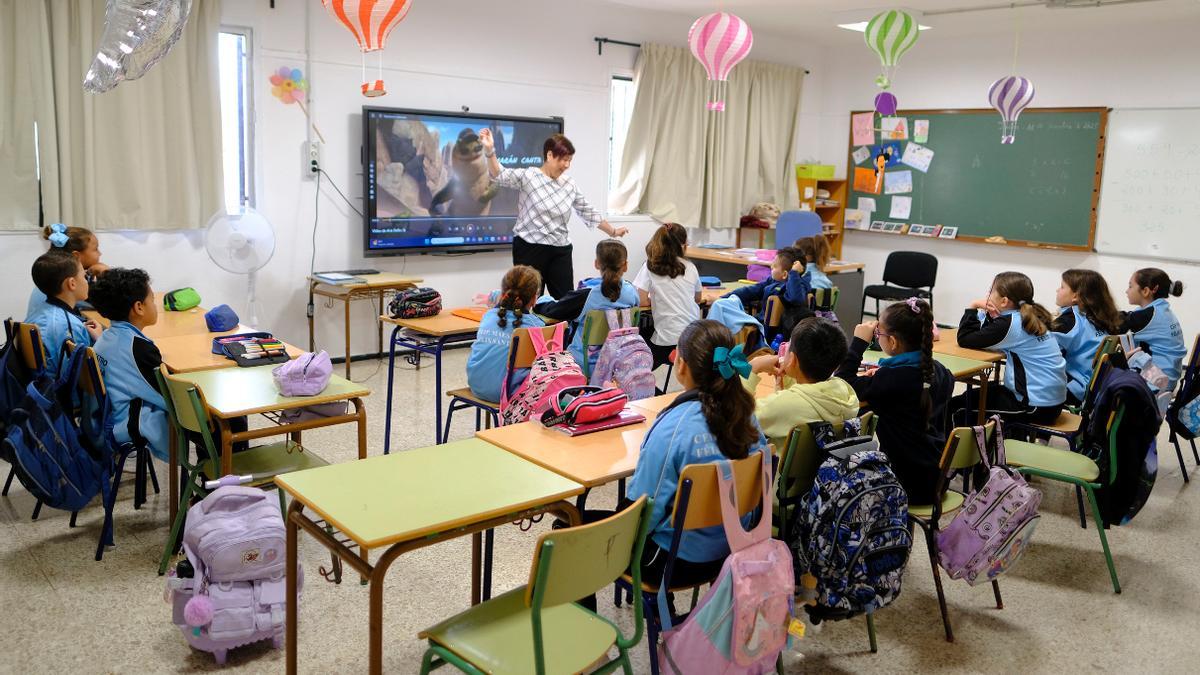
Ana Delia Miranda, a teacher at the CEIP Maestro Félix Santana in Gran Canaria, has been using AI-worked educational resources since last academic year. They introduced the tool through a school musical, generating the stage backdrops via an AI platform and then projecting the images onto screens. This year they have used it again for a new musical but have also decided to incorporate those AI-generated characters into the school curriculum.
Consequently, they have chosen to convey core knowledge for subjects like Spanish Language, Mathematics, or English through characters created with AI. Possessive adjectives, demonstratives, or subtraction with borrowing are understood better with these videos, which are also adapted to all educational levels. Miranda has been learning independently to develop these resources for her pupils. “Young people are captivated by imagery today, so these tools are proving very powerful for us,” celebrates the teacher, who states that even pupils with specific educational support needs can benefit from these advances. “I don’t believe it is the enemy of the teaching staff,” expresses Miranda, who clarifies, however, that “the pupils are not yet ready to use AI in their day-to-day lives.”
No post found!