
Industry and Government Slam “Revenue-Grabbing” Airport Fee
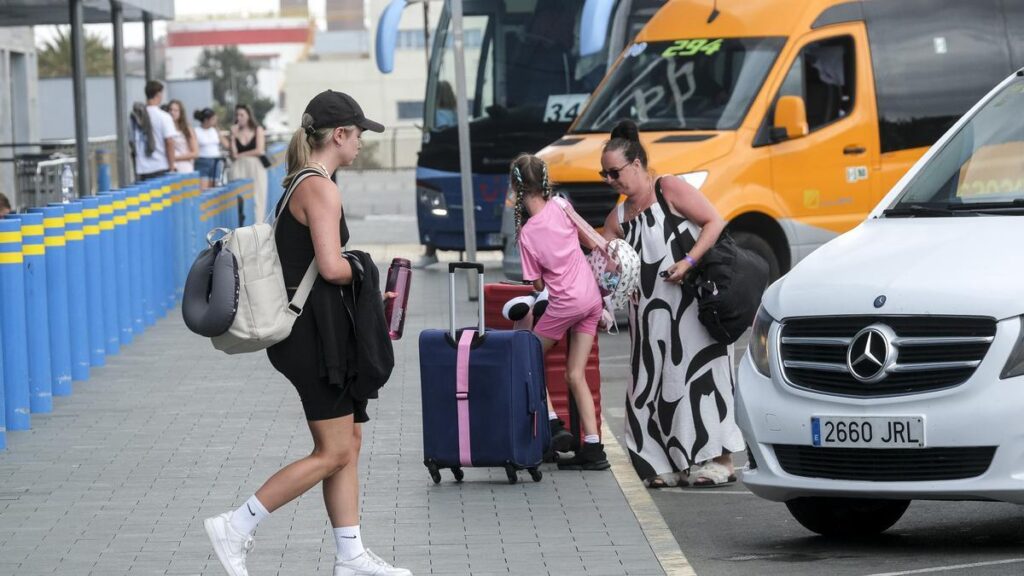
The Canary Islands’ autonomous government and the leading tourism and transport business organisations stood firm this morning against a fee that airport operator Aena wants to impose on tourist coaches picking up and dropping off passengers at the archipelago’s airports. Both the sector and the regional government agree that the measure weakens competitiveness, contradicts sustainable mobility policies, and has been pushed through without prior dialogue or solid technical justification. They expressed this position at a meeting this morning at the Canarian Confederation of Business Owners (CCE).
A “Bad Policy” That Penalises Collective Transport
The Regional Minister for Public Works, Housing and Mobility, Pablo Rodríguez, highlighted the impact of the decision and attacked the airport manager’s argument about a lack of space. In his view, the charge is for an “exclusively revenue-grabbing purpose” and is based on “excuses to cover up the real aim”. Furthermore, he warned that “any policy that penalises collective transport is a bad policy”, defending the bus as a key alternative to the private car in a territory where road infrastructure is under increasing pressure.
Historic Demand for Airport Co-Management Revived
Rodríguez linked the rejection of the fee to a historic demand of the Archipelago: airport co-management. Invoking Article 161 of the Statute of Autonomy of the Canary Islands, he demanded the community’s participation in strategic decisions about its airports and announced that the Canarian Government will promote a legislative initiative if the State does not back down. “If they don’t do it, we will. We will promote a law to establish the participation of the Canary Islands in the management of the airports,” he stated.
Sector Denounces Lack of Dialogue and Hidden Costs
The president of the CCE, Pedro Ortega, joined the criticism of Aena’s methods. He denounced that the measure has been processed “through the back door, with malice and in a lightning-fast manner”, and stressed that the new charge “introduces costs that damage the competitiveness of the tourism sector” and “goes against the defence of collective transport”, in a region where “the only way tourists arrive is through the airports”. From the Canary Islands Transport Business Federation (FET), its general secretary, José Ángel Hernández Ponce, provided data to gauge the economic impact. Around 150 companies dedicated to tourist transport operate in the Canaries, with some 4,500–4,700 coaches. According to figures provided by operators in the Balearic Islands – where this fee is already paid – the extra cost in Palma de Mallorca is around €6,000 per company per month, although he insisted the problem is not just financial. “It’s not just the money. This is a frontal attack on the Canary Islands’ mobility system,” he said.
“Courtesy Hour” Dismissed and Wider Impacts Warned
He also dismantled the usefulness of the so-called cost-free courtesy hour announced by Aena. “It means nothing. The coaches have to be there an hour earlier due to tour operator requirements, so they will pay regardless,” he added. The president of the Las Palmas Hospitality and Tourism Business Federation (FEHT), José María Mañaricua, broadened the focus to the social and environmental impact. He warned that the charge could trigger a shift towards private vehicle hire, which would increase saturation on already congested roads. “These are measures that go against sustainability as it is conceived in Europe,” he stated.
Government Seeks Answers and Points to Alternatives
Minister Rodríguez also recalled that the Government sent letters to the Ministry of Transport – the majority owner of Aena (51%) – to ask that the general interest be prioritised over revenue collection. For now, he acknowledged, there is no formal response, although there have been informal contacts with the company’s managers in the Canaries. He also cited the example of Palma de Mallorca, where an external, asphalted holding area annexed to the airport was set up, an alternative which, he argued, “could be implemented in practically 100% of the Canary Islands’ airports”.
No post found!