
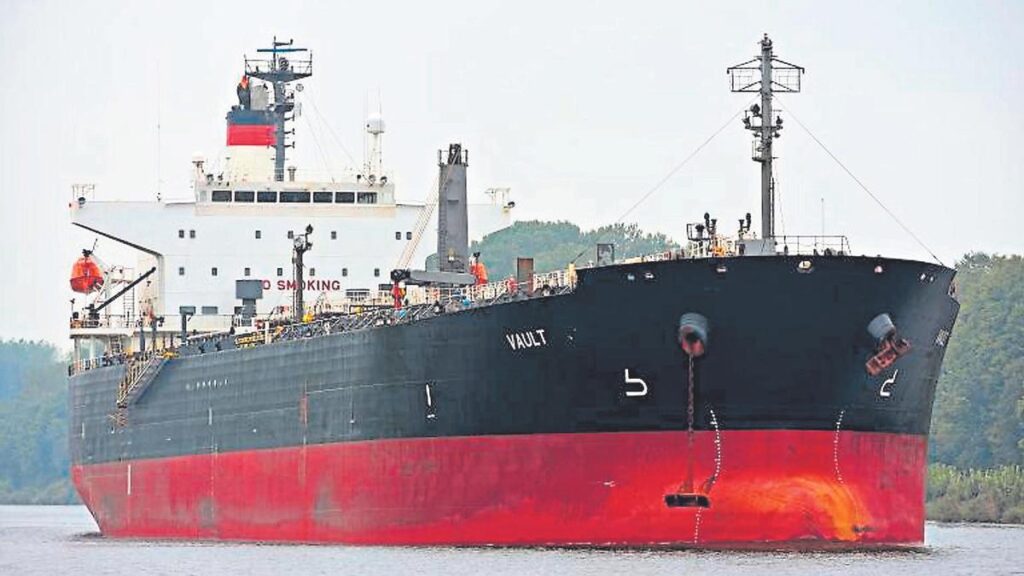
Sanctioned Tanker Seeks Refuge South of Tenerife
The United States’s siege of Russian and Iranian ‘ghost’ tankers entering Venezuela to load crude or offload fuel has forced several involved vessels to alter their routes to avoid the encirclement by the American military fleet. Some of these ageing ships are now approaching waters near the Canary Islands. This is the case with the Agate, a tanker sanctioned by the Trump Administration and the European Union (EU), which has been in international waters south of Tenerife for several days.
Evading the US Blockade
According to the latest information, this vessel was transporting naphtha—a petroleum derivative similar to petrol—destined for Venezuela, skirting sanctions and the surveillance of the US Navy, which patrols between the Caribbean and waters near the South American country. The Agate is subject to multiple international sanctions: it is on the blacklist of the Paris-Tokyo MoU (flagless until June or flying a false flag) and on the US Coast Guard’s list of flagged vessels. It forms part of the ‘dark fleet’ that sails the world and is in the crosshairs of the US Government for traversing the Atlantic as part of the illegal oil traffic with origin or destination in Venezuela.
The ship is in international waters but within Spain’s Exclusive Economic Zone (EEZ), which extends south and west of the Canaries. Last week, President Donald Trump tightened the screws on his siege of the regime of Venezuelan President Nicolás Maduro by blocking all sanctioned tankers bound for or from the country, targeting the Chavista regime’s primary source of income.
Altered Courses and Averted Journeys
Late last week, between Thursday and Friday, several vessels from the Russian ghost fleet were sailing towards Venezuela, but only one, the Hyperion, anchored on Friday near the Bay of Amuay on Venezuela’s western coast. It had loaded near Murmansk, Russia, in late November. However, the Angolan-flagged Agate, which loaded in Russia and had been sailing towards the Caribbean, changed direction on Friday. According to its trajectory, this vessel left the Turkish port of Istanbul on 8 December bound for the Caribbean but never reached its destination, like other ships, due to pressure from US warships, which have already seized two tankers.
This change of course has led it to this area of the Atlantic, specifically in international waters south of Tenerife but within Spain’s EEZ. Another sanctioned tanker, the Beninese-flagged Boltaris, which was transporting some 300,000 barrels of Russian naphtha to Venezuela, turned around at the start of the month and headed for Europe without unloading. Similarly, other vessels have also been redirected to other destinations in the Caribbean to escape pursuit by US ships.
The Growing ‘Dark Fleet’ Phenomenon
The presence of the so-called Russian ghost fleet has become a constant in the world’s seas since sanctions against Russia began following the invasion of Ukraine. These are old tankers with flags of convenience, no insurance, and navigation systems that evade surveillance and radar. It is estimated that over a thousand vessels of this type are sailing, escaping the control of Europe and the US.
But things have changed in recent months due to the pressure the Chavista regime is under from the Trump Administration, as one of the primary destinations for this ghost fleet is Venezuela. The Maduro regime supplies crude to Russia in exchange for Putin’s aid to Chavismo in facing American harassment. Drone attacks by Ukraine on these vessels in the Black Sea and Mediterranean are also taking a toll. In recent weeks, the US has seized two tankers and pursued a third. Although one was not sanctioned, Washington’s directive was clear from the first assault: take the ship’s fuel and immobilise the vessel. Maduro’s protests have been to no avail, and Trump is determined to strangle the Venezuelan economy by attacking its main source of income.
Canarian Waters: A Crossroads of Geopolitical Tension
The Canary Islands have always been a thoroughfare for all types of ships between three continents, through the international waters surrounding the Islands. Since sanctions on Russia began, the transit of Russian tankers near the Islands has been frequent, carrying the risk of some type of crude oil spill due to the lack of control over this fleet sailing under flags of convenience and sometimes even flagless, which is prohibited.
To this situation is now added the open conflict by the Trump Administration with Venezuela and Colombia, the echoes of which are reaching the vicinity of the Canaries. A few days ago, it emerged that the Colombian government of Gustavo Petro had seized 18 tonnes of cocaine in waters near the Canaries in its stand-off with the US, which accuses both Petro and Maduro of being behind drug trafficking networks reaching North America.
Now, the waters surrounding the Canaries are back in the news because one of the Russian oil tankers seeking oil from Venezuela or carrying naphtha shipments to the Chavista regime is anchored south of Tenerife, after shying away from its original trajectory as it approached Caribbean coasts under pressure from the US war fleet. Navigation maps indicated the vessel’s port of destination was scheduled for 27 December, but as of today, it is not known for certain how many days the tanker will be ‘stranded’ in its current location.
No post found!