
Canarian Company to Lead Trial for Promising ALS Treatment
A Canary Islands-based company has been tasked with leading the clinical trial for a promising new treatment designed to slow the progression of Amyotrophic Lateral Sclerosis (ALS). The drug, named DP2, combats the neurodegenerative disease in a novel way. It uses a new protein pathway action developed in Spanish laboratories, which has demonstrated an ability to slow and even reverse the disease in patient cells and mice.
The Devastating Impact of ALS
ALS is currently a fatal disease. According to data from the Spanish Society of Neurology, some 4,000 to 4,500 people in Spain suffer from it. The Canary Islands is one of the regions with the highest incidence of this condition, with around 80 diagnosed patients in Tenerife alone. While most cases are due to environmental causes, about 3% are of genetic origin.
The treatment currently available, however, is very limited. The fatal prognosis for patients with this rare disease can only be slowed by a few months. To date, the only approved drug for its treatment is Riluzole, a compound that only provides an increase in life expectancy of three to six months. DP2, however, could radically change the prognosis.
A Potential Game-Changer
“When we tested this molecule in genetically modified mice bred to develop ALS, the cognitive deficit was recovered,” states Ana Martínez, a chemist from the Spanish National Research Council (CSIC), one of those responsible for the discovery and the project’s lead researcher. In fact, the effects of this molecule are multiplied when mixed with Riluzole.
Martínez has spent decades working alongside her colleague Carmen Gil in search of promising molecules that could help treat neurodegenerative diseases. Their innovations have been achieving such promising results for so many years that they attracted the attention of Arquimea, a company dedicated solely to R&D, which established itself in the Canary Islands in 2019 through a research centre. Although they have tested many molecules over the years, DP2 is one of the most advanced and promising.
How the New Drug Works
The molecule that makes up DP2 acts against a specific protein linked to the onset of ALS. Part of this disease—which is multifactorial—is related to anomalies in the TDP43 protein. However, there is another protein, CK1, a kinase, which acts upon it, becoming the main agent responsible for causing those fatal modifications.
Specifically, CK1 acts by adding phosphate to TDP43, which drives the protein ‘mad’. It then stops accumulating in the nucleus of neurons—where it normally resides—and begins to lodge in the cytoplasm (the fluid surrounding the cell nucleus). “This mislocalisation and erroneous modifications cause the cells to malfunction until they die,” reveals Ruiz, who insists that this death of motor neurons is what causes a “disconnection” between the brain and the muscular system, which is the main consequence of ALS.
Tenerife at the Heart of Development
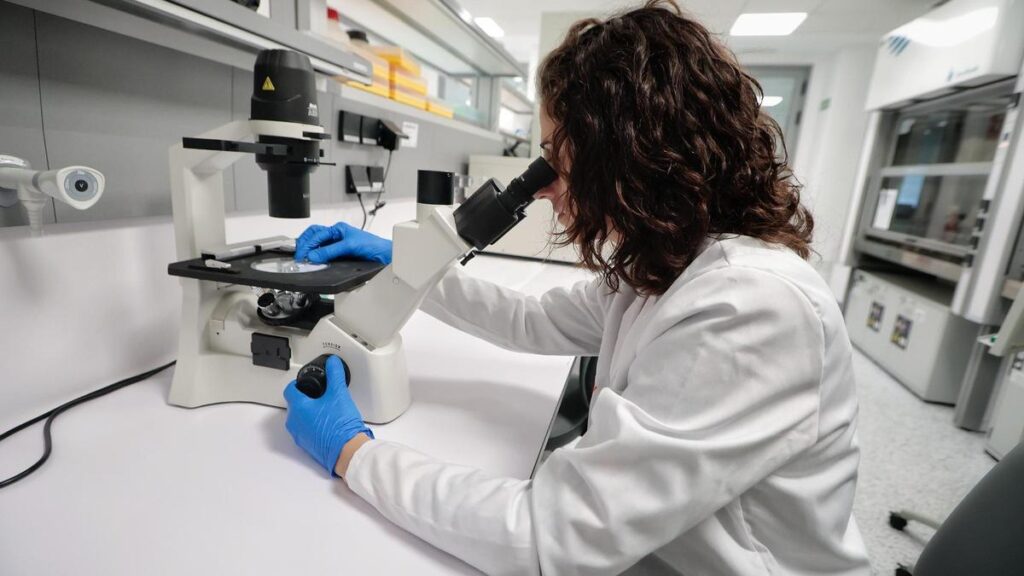
Molefy Pharma, a spin-off from the Arquimea Research Centre based in Tenerife, will be responsible for testing its efficacy and, eventually, bringing it to market. From its facilities in Las Mantecas (La Laguna), a small team is organising and developing the clinical study, which is about to begin after the European Medicines Agency (EMA) certified this innovation as an orphan drug.
“This has several benefits, including lower costs for advancing through the various phases, greater preference for carrying out the necessary procedures, and ten years of patent protection,” explains Mercedes Ruiz, senior researcher at Arquimea, the parent company of Molefy. The plan is to execute the various trial phases between 2026 and 2030.
The Road to Clinical Trials
The Phase I trial, intended to determine the drug’s safety, is about to begin at the Hospital de La Paz in Madrid. “First, we will recruit healthy volunteers to check the drug’s safety and, subsequently in this same phase, we will conduct a trial on 28 selected ALS patients,” explains Ana Martínez. If all goes well, Phase II could begin in 2028.
This stage of clinical trials is intended to verify the efficacy of this molecule in patients with the disease. “In this phase, we intend to extend it to patients across Spain,” Martínez emphasises. Her words are confirmed by Mercedes Ruiz, who states that in that phase, a multicentre study can be conducted which will also include Canarian patients.
For now, however, not all ALS patients will be able to enter this study. “They have to meet certain requirements for the study to be correct,” warns Ruiz. Nevertheless, the ultimate goal of this entire process the company has embarked upon is to obtain a marketable drug that is available for all types of patients.
No post found!