
National Pass Excludes Canaries, But Local Scheme Faces Its Own Challenges
The new €60 monthly national transport pass, which will allow unlimited travel on the state-run public transport network, does not apply to the Canary Islands at all. Here, buses and the Tenerife tram have been free for residents since 2023 and will remain so at least until 2027, thanks to the Sustainable Mobility Law passed in November. The national measure, presented on 15 December by the President of the Government, Pedro Sánchez, as a flat monthly fee valid across the country – except in the archipelago – aims to reduce the cost of daily travel and replace the multitude of temporary subsidies and discounts applied since 2022. However, the ongoing controversy surrounding it is not transferable to the Canaries, where, as is well known, there are no conventional commuter or medium-distance trains, nor state-managed long-distance intercity buses (these are all run by island or municipal councils under concessions from the Ministry of Transport).
Local Leaders Criticise “Discriminatory” National Scheme
“It is discriminatory,” state both the President of the La Gomera Island Council, Casimiro Curbelo, and the Tenerife Council’s Head of Mobility, Eulalia García. Furthermore, both argue that this new state pass is worse than the Resident Pass applied in the archipelago, as it does not include metros, urban buses, or trams – the daily transport for millions of citizens. The Sánchez government wants to achieve for the rest of the country what the Canaries did accomplish with free public transport: a significant increase in the use of buses and trams. Perhaps for this reason, the Minister of Transport, Óscar Puente, should have listened since last May to the proposal from the regional minister Pablo Rodríguez, who suggested the archipelago become a ‘pilot autonomous community’ to develop a possible single pass for all of Spain.
Rodríguez proposed that the state participate in work already being carried out by the Canary Islands Technological Institute (ITC), with the help of the island councils, to implement a pass that would allow Canarians to use a single ticket across all islands. He recalls that thanks to the island resident passes created in 2018 – when he was vice-president in Fernando Clavijo’s first term – it was later possible to “more easily materialise free transport on all islands and gradually consolidate a more sustainable form of mobility, achieving that 30.3% of users of the Canary Resident Pass leave their car behind.” This figure rises to 37.4% on the non-capital islands, where private vehicles were previously essential.
Success Brings Strain: Overcrowding and Maintenance Issues
These figures are accurate, forming part of a study by the Perfiles Canarias Institute on the impact of free buses – it does not include the tram – commissioned by Rodríguez’s own Ministry of Public Works and Transport. However, it is equally true that this increase in users causes “greater and faster wear and tear on equipment,” increasing “breakdowns and reducing the overall comfort of the buses, especially in peripheral municipalities and interurban routes.” Additionally, there are specific complaints about maintenance, particularly regarding accessibility for people with reduced mobility.
In short, although the free service is viewed positively (92.2%), there is a widespread consensus that the increase in use has also negatively affected service quality, which is managed by the seven island councils. Citizen complaints therefore fall directly on the island corporations, which are now immersed, together with the regional government, in creating a single pass for the entire Canary Islands, as the state has done for mainland Spain.
Funding Delays and Political Conflict Hinder Improvements
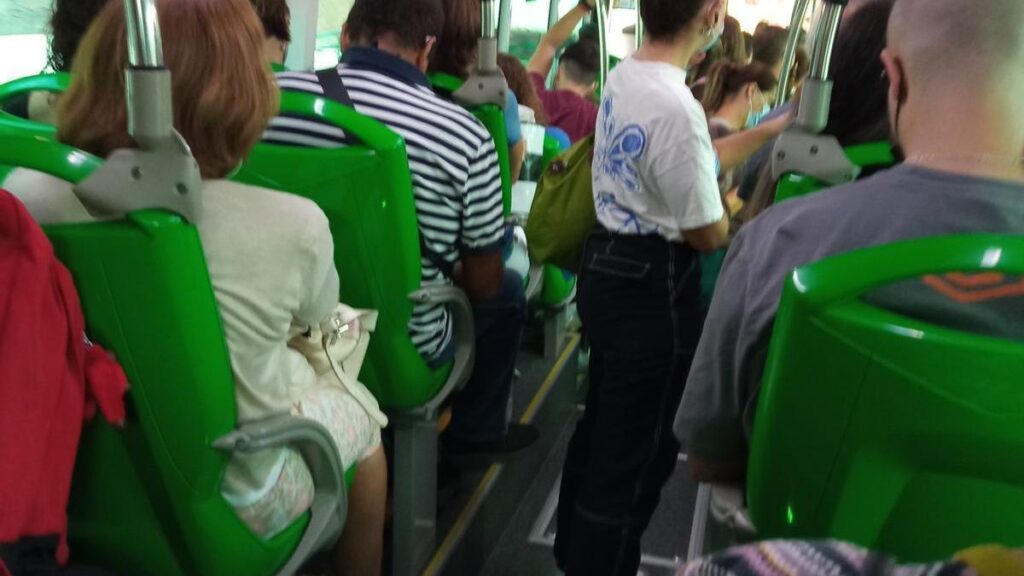
Users point out that infrastructure, frequencies, and timetables “have not been adequately adapted to the significant increase in passengers generated by the free scheme, aggravating pre-existing problems.” This lack of adaptation by island managers to the significant surge in demand causes “service saturation, especially during peak hours or on weekends, affecting the comfort and effective accessibility of the service due to overcrowding on buses.”
The challenge for the local corporations involved in urban and interurban public transport is therefore to reinforce frequencies, improve infrastructure, and modernise and adapt the fleet to guarantee an efficient and sustainable service over time. This is where the political conflict centres, as the state – with budgets rolled over since 2024 – is slow to transfer the funds to finance 100% of the free scheme. This forces the island councils and the regional government itself to pay with money from their own budgets – funds that are actually from the state – which they cannot then allocate to modernising or increasing the fleet to eliminate the feeling of saturation reported by users.
The consulted councils insist that the real cost exceeds the committed funding to meet ever-growing demand, without being able to proportionally increase investment in more staff and vehicles. A situation that is worsening on the non-capital islands. “Let’s see how long the money takes this time,” states Curbelo.
Social Benefits Versus “Irrational Use”
Furthermore, although free transport facilitates access for vulnerable groups or those with fewer economic resources – the unemployed, pensioners, or young students – and in this sense ensures mobility is not a factor of social exclusion and promotes equal opportunities, it also carries the noted disadvantage of “irrational use” and “abuse” of public transport. Some users now take it “for very short journeys they previously made on foot, causing saturation that negatively affects people who need to catch buses for essential travel” related to work, health, or studies. A behaviour that “is reinforced by the requirement to make a certain number of journeys to maintain the free access.”
No post found!